
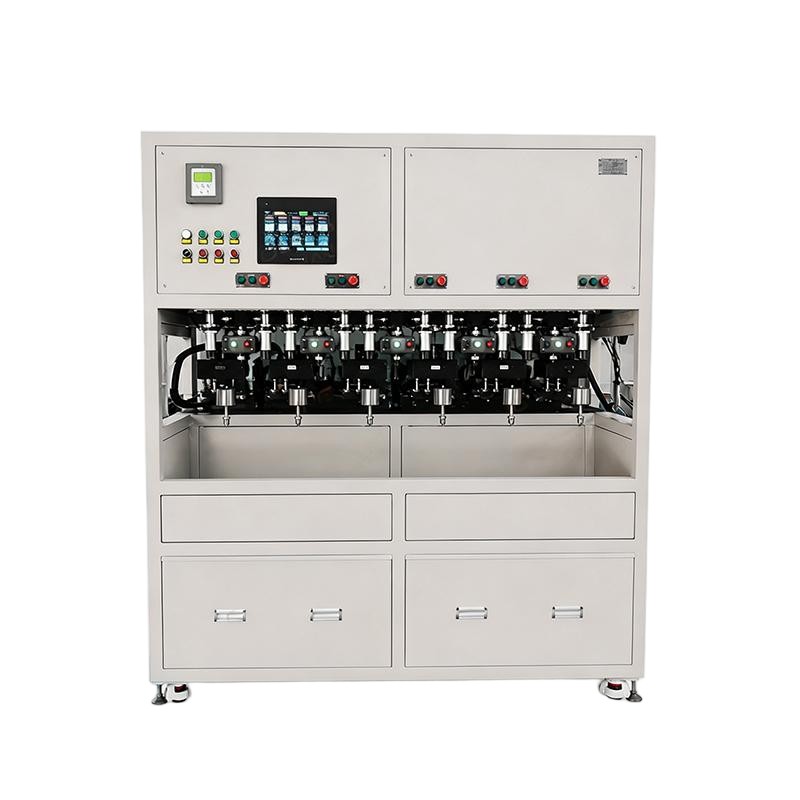
Vacuum Filling Machine: Working Principle and Selection Guide
1. What Is a Vacuum Filling Machine?
A vacuum filling machine is industrial equipment that uses negative pressure to support liquid filling operations.
First, the machine reduces the air pressure inside a container or workpiece. This process removes some of the trapped air. Next, the equipment introduces liquid through a controlled filling system.
Depending on the application, the machine may use vacuum-assisted filling, vacuum-to-liquid filling, or a combination of vacuum and pressure control.
Unlike conventional filling equipment, vacuum-based systems address air entrapment during filling. Consequently, they can improve filling consistency in applications with narrow internal passages or enclosed spaces.
A typical system may handle:
- Water-based liquids
- Thermal working fluids
- Coolants
- Specialized industrial liquids
- Other application-specific process fluids
However, material compatibility remains essential. Manufacturers must consider liquid viscosity, chemical properties, temperature, and contamination requirements.
2. Why Is Vacuum Filling Important?
Air trapped inside a component can affect product quality. In addition, bubbles may interfere with liquid distribution and reduce the reliability of certain assemblies.
A vacuum filling machine helps address these problems through controlled air removal and liquid introduction.
2.1 Reduce Trapped Air
First, vacuum extraction removes air from the target space. This step can reduce air pockets during subsequent filling.
It is particularly useful when a component contains narrow channels or enclosed cavities.
2.2 Improve Filling Consistency
Controlled vacuum and filling parameters help standardize the process. Therefore, manufacturers can achieve more repeatable results across production batches.
However, actual filling accuracy also depends on liquid properties, equipment design, and process calibration.
2.3 Support Complex Internal Structures
Some components contain small passages that make conventional filling difficult. Vacuum assistance can help liquid enter these spaces.
Nevertheless, the machine must match the internal geometry and filling requirements of the workpiece.
2.4 Improve Process Control
A modern vacuum filling system can integrate several controlled operations.
For example, it may include vacuum generation, liquid metering, filling valves, and process monitoring.
As a result, operators can manage important production parameters through a centralized control system.
3. How Does a Vacuum Filling Machine Work?
The working principle involves air extraction, liquid preparation, controlled filling, and process verification.
The exact sequence varies according to the product and filling method.
3.1 Workpiece Loading
First, the operator places the workpiece into the filling fixture.
The fixture positions the component and connects it to the vacuum and filling lines.
For automated systems, conveyors or robotic handling devices can perform loading and unloading.
3.2 Vacuum Extraction
Next, the vacuum pump removes air from the workpiece or processing chamber.
The control system monitors pressure during this stage.
The required vacuum level depends on the internal structure, material properties, and process requirements.
3.3 Liquid Preparation
Meanwhile, the filling system prepares the required liquid.
Depending on the application, preparation may include filtration, degassing, temperature control, or circulation.
These operations help maintain stable liquid conditions before filling.
3.4 Controlled Liquid Filling
After reaching the specified process conditions, the machine introduces liquid.
A metering device or controlled filling valve regulates the liquid supply.
Some systems maintain vacuum during filling. Others use pressure differences to move liquid into the workpiece.
The selected method depends on the product design and required filling performance.
3.5 Pressure Recovery
After filling, the system follows a controlled pressure recovery process.
This step may include closing the filling valve, isolating the workpiece, and returning the chamber to atmospheric pressure.
The equipment then releases the finished component.
3.6 Inspection and Verification
Finally, operators inspect the filled product.
Depending on the application, inspection may include:
- Filling quantity verification
- Leakage testing
- Visual inspection
- Pressure testing
- Functional performance testing
These checks help confirm that the filling process meets production requirements.
4. Main Components of a Vacuum Filling Machine
A complete vacuum filling machine combines several mechanical, electrical, and fluid-handling systems.
Each component supports a specific stage of the process.
4.1 Vacuum Pump
The vacuum pump removes air from the chamber or workpiece.
Its selection depends on the required vacuum level, pumping speed, operating cycle, and gas load.
Different applications may require different pump technologies.
4.2 Vacuum Chamber
The vacuum chamber provides a controlled environment for the filling operation.
Its size and structure depend on the workpiece dimensions and production requirements.
The chamber also needs suitable sealing arrangements to maintain stable vacuum conditions.
4.3 Liquid Storage Tank
The liquid storage tank holds the process fluid before filling.
Depending on the application, it may include liquid-level monitoring, filtration, temperature control, or circulation.
Material selection must also consider liquid compatibility.
4.4 Filling Pump and Metering System
The filling system transfers liquid into the target component.
A metering device helps control the required filling quantity.
Common configurations include flow-based, weight-based, and volume-based measurement systems.
The appropriate method depends on the liquid and product requirements.
4.5 Valves and Connecting Pipelines
Valves regulate vacuum extraction and liquid transfer.
Meanwhile, pipelines connect the chamber, vacuum pump, storage tank, and filling head.
Manufacturers should select suitable seals and pipeline materials to prevent leakage and contamination.
4.6 Control System
The control system manages the operating sequence.
It may include a PLC, touchscreen interface, sensors, and safety interlocks.
Depending on the equipment configuration, operators can adjust:
- Vacuum pressure
- Vacuum holding time
- Filling quantity
- Filling duration
- Liquid temperature
- Process sequence
These parameters should follow the validated production process.
5. Different Types of Vacuum Filling Machines
Vacuum filling equipment comes in different configurations. Manufacturers should select a machine according to product structure, liquid characteristics, and production volume.
5.1 Vacuum-Assisted Filling Machine
This machine uses vacuum conditions to reduce air inside the target container or component.
After evacuation, the equipment introduces liquid through a controlled filling system.
It suits applications where trapped air affects filling quality.
5.2 Vacuum Chamber Filling Machine
This configuration places the workpiece inside a sealed chamber.
The system creates a vacuum environment before introducing liquid.
It can handle products with complex shapes or multiple internal spaces, provided the chamber and fixtures match the workpiece.
5.3 Automatic Vacuum Filling Machine
An automatic vacuum filling machine integrates loading, evacuation, filling, and unloading operations.
It reduces manual handling and supports repeatable production cycles.
Additionally, automation can connect the machine with upstream and downstream equipment.
5.4 Multi-Station Vacuum Filling Machine
A multi-station design allows several workpieces to undergo different process stages.
For example, one station may perform loading while another performs vacuum extraction or filling.
This arrangement can improve production efficiency when the process and product structure support parallel operations.
6. Key Factors Affecting Filling Quality
Filling quality depends on several interacting variables. Therefore, manufacturers should evaluate the complete process rather than focusing on vacuum pressure alone.
6.1 Vacuum Level
The vacuum level influences air removal inside the workpiece.
However, a higher vacuum does not automatically guarantee better filling.
The required level depends on the material, internal geometry, liquid properties, and process design.
6.2 Liquid Viscosity
Liquid viscosity affects flow resistance.
High-viscosity liquids may require different filling conditions from low-viscosity fluids.
Therefore, the equipment must match the actual process fluid.
6.3 Filling Quantity
The target filling quantity depends on the product design.
An unsuitable metering method may cause overfilling or underfilling.
Manufacturers should define acceptable filling tolerances before equipment selection.
6.4 Temperature
Temperature can change liquid viscosity and flow behavior.
For this reason, some applications require temperature monitoring or conditioning.
Stable liquid conditions help improve process repeatability.
6.5 Sealing Performance
Vacuum leakage can interrupt the filling cycle.
Consequently, chamber seals, pipeline connections, valves, and workpiece interfaces require careful inspection.
6.6 Process Timing
Vacuum extraction time and filling duration affect production efficiency.
An excessively short cycle may not achieve the required process conditions.
However, unnecessarily long cycles can reduce output.
Manufacturers should establish suitable timing through process testing.
7. Industrial Applications of Vacuum Filling Equipment
Vacuum filling technology serves industries that require controlled liquid introduction into containers or enclosed components.
The specific machine design varies with the product and production process.
7.1 Thermal Management Components
Some thermal management products require accurate liquid filling.
Vacuum-assisted processes can help remove trapped air before introducing working fluids.
For heat pipe manufacturing, however, the complete process may also require evacuation, degassing, fluid charging, and sealing.
A general-purpose vacuum filling machine does not automatically replace specialized heat pipe manufacturing equipment.
Related internal links:
- Heat Pipe Production Line
- Heat Pipe Equipment Production Line
- Heat Pipe Fluid Filling Machine
- Copper Heat Pipe Vacuum Degassing Machine
- Heat Pipe Filling & Welding Machine
7.2 Electronic Components
Certain electronic assemblies contain sealed spaces or internal cavities.
Vacuum-assisted filling may help introduce suitable liquids into these structures.
The process must account for electrical insulation, material compatibility, and contamination control.
7.3 Automotive Components
Automotive manufacturing uses controlled filling processes for various components and assemblies.
Depending on the product, vacuum assistance may help reduce trapped air during liquid introduction.
The machine configuration should match the component’s geometry and production requirements.
7.4 Industrial Equipment
Some industrial assemblies require liquids inside enclosed spaces.
A vacuum filling machine can support controlled filling operations when conventional methods cannot achieve consistent results.
Manufacturers should validate the filling process before introducing the equipment into mass production.
8. How to Choose the Right Vacuum Filling Machine
Choosing suitable equipment requires a clear understanding of the workpiece and production process.
The following factors provide a practical selection framework.
8.1 Define the Workpiece
Start by identifying the product dimensions and internal structure.
Consider the following information:
- Workpiece length and diameter
- Internal cavity volume
- Filling port design
- Material composition
- Required filling quantity
- Production batch size
These details help determine the chamber size and fixture configuration.
8.2 Confirm Liquid Characteristics
Next, identify the process fluid.
Important properties include viscosity, density, temperature range, chemical compatibility, and vapor pressure.
These characteristics affect pump selection, pipeline design, and filling control.
8.3 Establish Vacuum Requirements
Define the required vacuum level and holding time.
Also, consider the workpiece’s ability to withstand external pressure.
For products with thin walls or delicate structures, pressure conditions require particular attention.
8.4 Determine Filling Accuracy
Clarify the required filling quantity and acceptable tolerance.
Then, select a suitable metering method.
For example, weight-based measurement may suit applications where liquid density and filling accuracy require careful control.
8.5 Evaluate Production Capacity
Estimate the required output per shift or production day.
Then, compare manual, semi-automatic, and fully automatic configurations.
A multi-station machine may be suitable for higher production demand.
However, equipment selection should consider actual cycle time and changeover requirements.
8.6 Check Automation Requirements
Consider whether the machine needs to connect with other production equipment.
Possible integration features include:
- Automatic loading and unloading
- Conveyor connections
- PLC communication
- Recipe storage
- Production data recording
- Automatic inspection
These functions can support more consistent manufacturing operations.
8.7 Review Maintenance Requirements
Finally, evaluate pump maintenance, seal replacement, liquid cleaning, and spare parts availability.
A practical equipment design should support routine maintenance without unnecessary downtime.
9. Integration with Automated Production Lines
A vacuum filling machine can operate independently or as part of an integrated manufacturing line.
For industrial production, integration helps coordinate material handling and process timing.
A typical automated system may include:
- Workpiece loading station
- Positioning and clamping station
- Vacuum extraction station
- Liquid preparation system
- Vacuum filling station
- Pressure recovery station
- Inspection station
- Finished product unloading station
The actual configuration depends on the product and manufacturing process.
9.1 Production Line Coordination
The filling machine must match the cycle time of connected equipment.
Otherwise, it may become a production bottleneck.
Therefore, manufacturers should evaluate the complete line before confirming machine capacity.
9.2 Process Data Management
A PLC-based system can record important process information.
For example, it may store vacuum pressure, filling quantity, and cycle time.
These records help operators monitor production consistency and investigate process deviations.
9.3 Flexible Product Changeover
Some factories manufacture different product models on the same line.
In this situation, adjustable fixtures and programmable process settings can simplify changeovers.
However, each product still requires appropriate process validation.
10. Common Vacuum Filling Problems and Solutions
Even well-designed equipment can experience process problems. Identifying the cause helps manufacturers maintain stable production.
Common Problem | Possible Cause | Recommended Action |
Unstable vacuum | Pipeline leakage or seal damage | Inspect connections and replace damaged seals |
Incomplete filling | Insufficient evacuation or restricted flow | Review vacuum conditions and filling paths |
Incorrect filling quantity | Metering deviation or unstable liquid supply | Calibrate the measurement system |
Air bubbles | Poor evacuation or unsuitable filling sequence | Review vacuum and filling parameters |
Slow filling cycle | High viscosity or pipeline resistance | Check liquid properties and pipeline design |
Liquid contamination | Dirty storage tank or pipelines | Improve cleaning and filtration |
Repeated process alarms | Sensor faults or incorrect settings | Inspect sensors and control parameters |
10.1 Unstable Vacuum Pressure
First, inspect the chamber and pipeline connections.
Then, check the sealing surfaces and vacuum pump condition.
A systematic leak test can help locate the problem.
10.2 Incomplete Liquid Filling
Incomplete filling may result from restricted flow or unsuitable vacuum conditions.
Check the filling head, valves, and pipeline layout.
Also, verify whether the liquid viscosity matches the equipment design.
10.3 Inconsistent Filling Quantity
Filling variation may result from unstable liquid supply or inaccurate metering.
Therefore, inspect the measurement system and recalibrate it when necessary.
Also, maintain consistent operating conditions between production cycles.
11. Maintenance and Operating Recommendations
Regular maintenance helps protect equipment performance and production stability.
Manufacturers should establish a maintenance schedule based on operating frequency and process conditions.
11.1 Inspect Vacuum Components
Check the vacuum pump, filters, valves, and connecting pipelines.
Replace worn seals when necessary.
Additionally, monitor vacuum performance to identify possible deterioration.
11.2 Clean Liquid Contact Parts
Clean tanks, pipelines, and filling heads according to the process requirements.
This practice helps prevent contamination and material buildup.
Use cleaning agents that are compatible with the equipment materials.
11.3 Calibrate Measurement Devices
Inspect pressure sensors, temperature sensors, and filling measurement systems.
Calibration helps maintain reliable process readings.
Follow the manufacturer’s recommended maintenance intervals.
11.4 Check Electrical and Control Systems
Inspect wiring, control cabinets, sensors, and safety interlocks.
Also, review alarm records to identify recurring faults.
11.5 Train Equipment Operators
Operators should understand the filling sequence and safety procedures.
They should also know how to respond to abnormal pressure readings and liquid leakage.
Proper training reduces operating errors and unnecessary downtime.
12. Why Work with an Industrial Equipment Manufacturer?
Industrial filling equipment should match the actual production process.
A standard machine may not suit every workpiece or liquid.
Therefore, manufacturers should evaluate equipment suppliers based on engineering capability and application understanding.
Important evaluation points include:
- Experience with industrial vacuum systems
- Understanding of liquid filling processes
- Custom fixture and chamber design
- Control system configuration
- Production line integration
- Equipment testing and commissioning
- Technical support and spare parts
For specialized thermal management applications, equipment selection should also consider the complete heat pipe manufacturing process.
cncooling-thermal focuses on equipment and production solutions related to heat pipes and vapor chambers. Visit cncooling-thermal.com to explore relevant manufacturing equipment and production line solutions.
13. Frequently Asked Questions
Q1. What is the main purpose of a vacuum filling machine?
Its main purpose is to introduce liquid under controlled vacuum conditions. It helps reduce trapped air and supports consistent filling in suitable industrial applications.
Q2. How does a vacuum filling machine work?
The machine first removes air from a chamber or workpiece. Then, it introduces liquid through a controlled filling system. Finally, it restores pressure and releases the filled component.
Q3. What liquids can a vacuum filling machine handle?
The suitable liquids depend on the machine design. Applications may include water-based fluids, coolants, thermal working fluids, and specialized industrial liquids. Always confirm chemical and material compatibility.
Q4. What is the difference between vacuum filling and ordinary filling?
Ordinary filling generally introduces liquid under atmospheric conditions. Vacuum filling uses reduced pressure to remove air before or during liquid introduction. This difference can improve filling in products with enclosed spaces.
Q5. Can a vacuum filling machine handle heat pipe production?
It may support certain vacuum-assisted liquid filling operations. However, heat pipe manufacturing requires specific process control. Dedicated equipment may combine evacuation, degassing, working fluid charging, and sealing.
Q6. What factors affect vacuum filling accuracy?
Important factors include vacuum stability, liquid viscosity, filling temperature, metering accuracy, and process timing. Workpiece structure also affects filling performance.
Q7. Can vacuum filling machines operate automatically?
Yes. Automatic configurations can integrate loading, vacuum extraction, filling, pressure recovery, and unloading. The automation level depends on production requirements.
Q8. How should manufacturers select a vacuum filling machine?
Start with the workpiece dimensions, liquid properties, filling quantity, and required vacuum conditions. Then, evaluate production capacity, automation, maintenance, and equipment customization.
Conclusion
A vacuum filling machine supports controlled liquid filling by combining air extraction and accurate fluid delivery.
Its performance depends on the workpiece, liquid properties, vacuum conditions, and equipment configuration.
Therefore, manufacturers should define their process requirements before selecting a machine. They should also evaluate automation, maintenance, and production line compatibility.
For heat pipe and vapor chamber manufacturing, specialized equipment may provide a more suitable solution than general-purpose filling systems.
By selecting equipment according to actual production needs, manufacturers can improve process consistency and build a more reliable manufacturing workflow.