
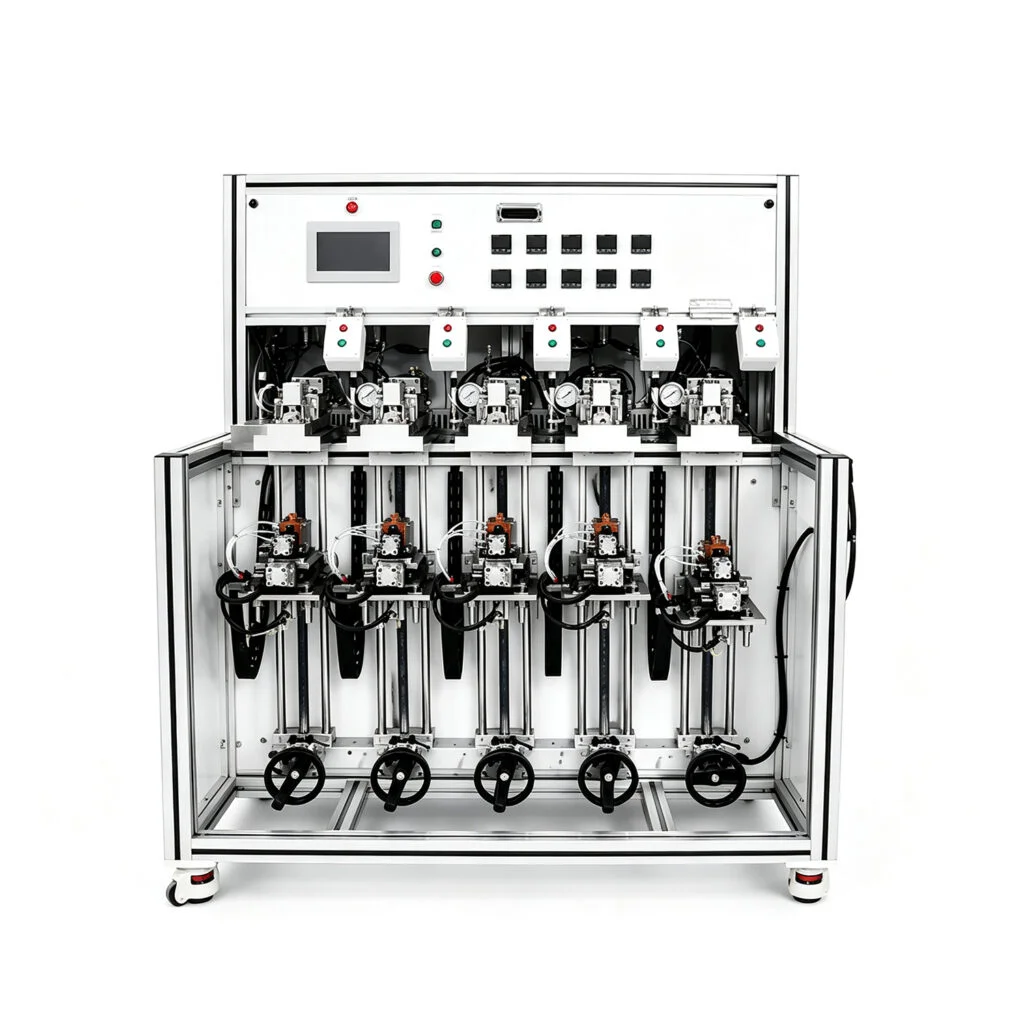
Automatic Secondary Degassing & Tail Welding Machine for Heat Pipe
1. What Is an Automatic Secondary Degassing & Tail Welding Machine for Heat Pipe?
An Automatic Secondary Degassing & Tail Welding Machine for Heat Pipe is specialized equipment used during heat pipe manufacturing.
It combines secondary vacuum degassing with tail-end welding. The machine processes heat pipes after earlier manufacturing and filling operations.
The secondary degassing stage helps remove residual non-condensable gases. Depending on the production process, it may also support further removal of unwanted gases and moisture.
After the required degassing conditions are achieved, the machine performs tail welding. This operation seals the designated filling or processing end of the heat pipe.
The machine may integrate several functions:
- Automatic workpiece loading and positioning
- Vacuum connection and evacuation
- Secondary degassing
- Heating control, where required
- Process pressure monitoring
- Tail-end welding
- Welding sequence control
- Automatic unloading
The exact configuration depends on the heat pipe structure and manufacturing requirements.
For example, copper heat pipes, different tube diameters, and different product lengths may require different fixtures and welding arrangements.
Therefore, manufacturers should define their product specifications before selecting equipment.
2. Why Are Secondary Degassing and Tail Welding Important?
Heat pipes transfer heat through evaporation and condensation of an internal working fluid. Their performance depends on the interaction between the working fluid, internal structure, and sealed environment.
Residual non-condensable gases can interfere with this process. In addition, poor sealing may cause leakage or changes in internal conditions.
Secondary degassing and tail welding address two important manufacturing requirements.
2.1 Remove Residual Non-Condensable Gases
Non-condensable gases do not participate in the normal evaporation-condensation cycle.
Instead, they can accumulate in parts of the heat pipe and reduce the effective heat transfer area.
This may increase thermal resistance and affect operating performance.
Secondary degassing helps reduce these residual gases before final sealing.
2.2 Support Stable Internal Conditions
A heat pipe needs suitable internal conditions for its working fluid to circulate effectively.
Residual gases and moisture may affect these conditions.
Therefore, manufacturers use controlled vacuum processes to improve internal cleanliness before sealing.
2.3 Complete the Sealing Process
After degassing, the designated tail must be sealed.
Tail welding closes the opening and helps maintain the required internal environment.
The welding process must produce a reliable joint without damaging the surrounding tube structure.
2.4 Improve Production Consistency
Manual degassing and welding may introduce variations between workpieces.
An integrated automatic machine can standardize positioning, vacuum operations, and welding sequences.
As a result, manufacturers can improve process repeatability and reduce unnecessary manual intervention.
3. How Does the Machine Work?
The machine combines vacuum processing and welding in a controlled sequence.
The exact workflow depends on the equipment design and the heat pipe manufacturing process.
A typical process includes the following stages.
3.1 Automatic Loading and Positioning
First, the operator or upstream automation system supplies the heat pipes.
The machine positions each workpiece in a dedicated fixture.
Accurate positioning is important because the vacuum connection and welding head must align with the designated processing area.
The fixture should accommodate the required product dimensions.
3.2 Connection to the Vacuum System
Next, the machine connects the heat pipe to the vacuum system.
Sealing interfaces help prevent unwanted air leakage during processing.
The equipment checks the connection before starting the evacuation sequence.
3.3 Secondary Vacuum Degassing
The vacuum pump removes residual gases from the heat pipe.
The system monitors pressure throughout the process.
Depending on the product and process design, the machine may also apply controlled heating.
Heating can support gas release from internal surfaces and materials. However, the temperature and duration must match the working fluid and heat pipe construction.
3.4 Vacuum Holding and Process Monitoring
After reaching the required vacuum condition, the system may maintain a holding period.
This stage allows the process to meet its specified degassing requirements.
Sensors and control equipment monitor relevant parameters.
The actual vacuum level and holding time should come from process validation rather than a universal setting.
3.5 Tail-End Preparation
After degassing, the machine prepares the designated tail for welding.
The system positions the welding area and applies the required clamping arrangement.
Depending on the design, this stage may include tube alignment, tail positioning, and welding electrode or tool positioning.
3.6 Automatic Tail Welding
The welding system seals the designated opening.
The welding method depends on tube material, wall thickness, geometry, and process requirements.
The equipment controls the welding sequence and relevant parameters.
Suitable welding conditions help produce a consistent joint while limiting excessive deformation.
3.7 Unloading and Inspection
Finally, the machine releases the processed heat pipe.
Operators or downstream equipment can perform inspection.
Typical checks may include:
- Weld appearance
- Sealing integrity
- Leakage testing
- Dimensional inspection
- Thermal performance testing
This final stage helps verify that the product meets manufacturing requirements.
4. Main Components of the Machine
A complete automatic secondary degassing and tail welding system combines vacuum equipment, fixtures, welding devices, and control systems.
Each subsystem contributes to the overall process.
4.1 Vacuum Pump System
The vacuum pump creates the required reduced-pressure environment.
Its selection depends on the required vacuum level, pumping speed, gas load, and processing cycle.
The vacuum system may also include filters, valves, vacuum gauges, and connecting pipelines.
A suitable pump configuration helps maintain stable process conditions.
4.2 Vacuum Processing Chamber or Connection Assembly
The chamber or connection assembly provides the interface between the heat pipe and vacuum system.
Its design depends on the machine configuration.
Important considerations include:
- Workpiece dimensions
- Connection structure
- Sealing method
- Vacuum leakage control
- Ease of cleaning and maintenance
4.3 Heating System
Some secondary degassing processes require controlled heating.
A heating system can support the release of residual gases and moisture.
However, excessive temperature may affect the working fluid, internal materials, or product structure.
Therefore, heating conditions must follow the validated process specification.
4.4 Tail Positioning and Clamping Fixture
The fixture holds the heat pipe in the correct position.
It also helps maintain alignment during welding.
A suitable fixture should provide stable clamping without crushing or deforming the tube.
For manufacturers with multiple product models, interchangeable fixtures can support product changeovers.
4.5 Welding System
The welding system performs the final tail sealing operation.
Its configuration depends on the selected welding technology.
It may include a welding power source, electrodes or welding tools, positioning mechanisms, and process control devices.
The welding system must match the material and geometry of the heat pipe.
4.6 Automatic Feeding and Handling System
Automatic handling equipment moves workpieces between processing positions.
Depending on the machine design, it may include:
- Pneumatic actuators
- Servo positioning systems
- Mechanical transfer devices
- Automatic clamps
- Loading and unloading mechanisms
These components reduce manual handling and support continuous production.
4.7 PLC Control System
The PLC coordinates the operating sequence.
Operators can use a touchscreen interface to select process settings and monitor machine status.
The system may manage:
- Vacuum pump operation
- Vacuum pressure monitoring
- Heating sequence
- Degassing duration
- Welding sequence
- Alarm handling
- Automatic loading and unloading
Process data recording may also support production traceability when included in the configuration.
5. Key Process Parameters
The quality of secondary degassing and tail welding depends on several parameters.
Manufacturers should establish suitable process windows through testing and validation.
5.1 Vacuum Level
Vacuum level affects the removal of residual gases.
An unsuitable vacuum condition may leave excessive gases inside the heat pipe.
However, the required level depends on the product structure and process requirements.
5.2 Degassing Time
Degassing time determines how long the system maintains the specified processing conditions.
Insufficient time may reduce gas removal effectiveness.
Excessively long processing can also reduce production efficiency.
Manufacturers should optimize the duration through process trials.
5.3 Heating Temperature
When the process includes heating, temperature control becomes essential.
The heating profile should account for the working fluid, tube material, wick structure, and other internal components.
Avoid using a fixed temperature for every heat pipe model.
5.4 Welding Energy
Welding energy affects the formation of the sealing joint.
Insufficient energy may cause incomplete welding.
Excessive energy may produce burn-through, deformation, or damage around the welding area.
Therefore, welding parameters require validation for each relevant product specification.
5.5 Welding Position and Clamping Force
Correct positioning helps maintain consistent weld geometry.
Meanwhile, suitable clamping force prevents movement during welding.
However, excessive clamping may deform thin-wall tubes.
5.6 Process Sequence
The order of vacuum treatment and welding must match the equipment design.
The machine should maintain the required internal conditions until the sealing operation is complete.
Manufacturers should verify the entire sequence through leak testing and product performance evaluation.
6. Secondary Degassing Methods for Heat Pipes
Secondary degassing methods vary according to the heat pipe design and production process.
The selected method should support effective gas removal without damaging the product.
6.1 Vacuum Degassing
Vacuum degassing reduces internal pressure and helps remove residual gases.
The vacuum system must match the workpiece volume and gas load.
Stable connections and effective sealing are important for reliable operation.
6.2 Vacuum Heating Degassing
Some processes combine vacuum extraction with controlled heating.
Heating can promote the release of gases and moisture from internal surfaces.
However, the process requires careful temperature management.
The working fluid and internal wick materials must remain within suitable conditions.
6.3 Multi-Stage Degassing
Some manufacturing processes use several vacuum stages.
For example, an earlier stage may remove most of the unwanted gases. A later stage can further condition the heat pipe before final sealing.
The exact number of stages depends on product requirements.
An automatic secondary degassing system can support this final conditioning stage.
6.4 Process Selection Considerations
When selecting a degassing method, manufacturers should consider:
- Heat pipe material
- Tube diameter and length
- Internal wick structure
- Working fluid
- Previous processing stages
- Required internal conditions
- Production cycle time
The best process is the one that meets product requirements with stable and repeatable results.
7. Heat Pipe Tail Welding Methods
Tail welding creates the final sealed joint.
The selected welding technology depends on material, wall thickness, tail geometry, and required joint quality.
7.1 Resistance Welding
Resistance welding generates heat through electrical resistance at the joint.
It can support automated welding cycles and controlled electrode movement.
However, electrode design, contact pressure, and electrical parameters require careful adjustment.
7.2 TIG Welding
Tungsten inert gas welding uses an electric arc and a non-consumable tungsten electrode.
It can produce controlled welds on suitable metal components.
However, automation requires stable positioning and carefully controlled welding conditions.
7.3 Laser Welding
Laser welding uses a concentrated energy beam to form the joint.
It can support precise welding and automated production.
Nevertheless, material reflectivity, joint geometry, surface condition, and equipment cost require consideration.
7.4 Selecting the Welding Method
No single welding method suits every heat pipe.
Manufacturers should evaluate:
Selection Factor | Why It Matters |
Tube material | Determines welding compatibility |
Wall thickness | Influences heat input and penetration |
Tail geometry | Affects joint accessibility |
Production volume | Influences automation requirements |
Joint appearance | Defines visual quality expectations |
Leak resistance | Determines sealing verification requirements |
Product deformation | Helps select suitable welding parameters |
The final method should be confirmed through sample welding and leak testing.
8. Benefits of Automatic Integrated Processing
Combining secondary degassing and tail welding offers several production advantages.
However, the actual benefits depend on machine configuration and process validation.
8.1 Reduced Manual Handling
An integrated machine can perform multiple operations within one equipment system.
Therefore, operators do not need to transfer every workpiece between separate processing stations.
This can reduce handling time and positioning variation.
8.2 Improved Process Repeatability
Automatic control helps standardize vacuum and welding sequences.
Operators can use defined process settings for different product models.
As a result, the system supports more consistent production conditions.
8.3 Better Production Coordination
Combining two process stages can simplify production line planning.
The machine can coordinate vacuum processing and welding within a defined cycle.
This arrangement may reduce unnecessary workpiece movement.
8.4 Easier Process Monitoring
A PLC-based system can monitor important operating conditions.
Depending on its configuration, it may record vacuum pressure, degassing time, and welding parameters.
These records help production teams investigate quality variations.
8.5 Support for Automated Manufacturing
Automatic loading, positioning, processing, and unloading can connect with upstream and downstream equipment.
This makes the machine suitable for production lines that require coordinated material handling.
9. Applications in Heat Pipe Manufacturing
An automatic secondary degassing and tail welding machine serves heat pipe production processes that require final vacuum conditioning and sealing.
Its application depends on the heat pipe type and manufacturing route.
9.1 Copper Heat Pipes
Copper heat pipes are widely used in thermal management products.
Their manufacturing process may include tube preparation, wick installation, cleaning, filling, degassing, and sealing.
The secondary degassing and tail welding machine supports the final stages of suitable production processes.
9.2 Electronics Cooling Heat Pipes
Electronic cooling applications require reliable thermal performance.
Heat pipes may appear in cooling assemblies for computers, power electronics, and other electronic products.
Consistent degassing and sealing help manufacturers control important product quality factors.
9.3 Heat Pipes for Industrial Equipment
Industrial thermal management systems may use heat pipes in different sizes and configurations.
The machine should accommodate the relevant tube dimensions and production requirements.
Dedicated fixtures can support stable processing of different models.
9.4 Customized Heat Pipe Products
Some manufacturers produce special shapes or non-standard dimensions.
In these cases, the machine may require customized fixtures, vacuum connections, and welding arrangements.
Early sample testing helps confirm equipment suitability.
10. How to Choose the Right Machine
Choosing the right automatic secondary degassing and tail welding machine requires more than comparing equipment prices.
Manufacturers should evaluate the machine against actual product specifications and production targets.
10.1 Confirm Heat Pipe Dimensions
Provide the supplier with the main product dimensions.
These may include:
- Tube diameter
- Tube length
- Wall thickness
- Tail dimensions
- Product shape
- Filling port position
The equipment fixture must accommodate these dimensions.
10.2 Identify Internal Product Materials
The internal wick and working fluid influence degassing conditions.
For example, different working fluids may require different temperature limits.
Manufacturers should share relevant material information with the equipment supplier.
10.3 Define Vacuum Requirements
Specify the required vacuum level and degassing time.
Also, identify whether the process requires heating or multiple vacuum stages.
These details determine the vacuum system and control configuration.
10.4 Select a Suitable Welding Method
Confirm the tube material and tail geometry.
Then, evaluate suitable welding technologies through sample testing.
The selected system should provide stable positioning and reliable joint formation.
10.5 Evaluate Automation Level
Determine whether the factory needs manual loading, automatic feeding, or a fully integrated process.
Consider the available factory space and existing equipment.
The machine should fit the actual production workflow.
10.6 Check Product Changeover Requirements
If the factory manufactures multiple heat pipe models, changeover time becomes important.
Ask whether the machine supports interchangeable fixtures and adjustable process settings.
Also, clarify how operators select different product recipes.
10.7 Request Sample Testing
Before confirming an order, provide representative heat pipe samples.
The equipment supplier can evaluate:
- Vacuum performance
- Degassing process
- Welding quality
- Workpiece positioning
- Cycle time
- Leakage test results
Sample testing helps reduce equipment selection risks.
11. Integration with a Complete Heat Pipe Production Line
The automatic secondary degassing and tail welding machine is one part of a larger heat pipe manufacturing system.
Its position depends on the production route.
A typical manufacturing process may include:
- Copper tube preparation
- Tube cutting and forming
- Wick structure installation
- Powder filling or sintering, where applicable
- Initial cleaning and degassing
- Working fluid charging
- Secondary degassing
- Tail welding and sealing
- Leakage inspection
- Thermal performance testing
The exact order may vary according to the heat pipe design and manufacturing method.
11.1 Connection with Fluid Filling Equipment
The secondary degassing and tail welding machine may connect with an upstream filling process.
The filling equipment introduces the required working fluid.
The following degassing and welding operations then help establish the final sealed internal environment.
The process sequence must match the specific machine design.
Suggested internal link: Heat Pipe Fluid Filling Machine
11.2 Connection with Vacuum Degassing Equipment
Some production lines use separate vacuum treatment stages.
In this configuration, the secondary degassing machine provides additional processing before final sealing.
Manufacturers should coordinate the vacuum requirements between different stations.
Suggested internal links:
- Copper Heat Pipe Vacuum Degassing Machine
- Automatic Heat Pipe Heating Degasser Machine
- Vacuum Filling Machine
11.3 Connection with Inspection Equipment
After tail welding, manufacturers should verify the product.
Leak testing checks sealing integrity.
Thermal performance testing evaluates the heat pipe’s functional behavior under defined test conditions.
Suggested internal links:
- Heat Pipe Multi-Station Dry-Out Tester
- Thermal Performance Testing Equipment
- Heat Pipe Thermal Performance Tester
11.4 Production Line Automation
The machine can connect with conveyors or automatic transfer devices.
A centralized control system may coordinate production status between different stations.
This approach helps manufacturers manage the overall process rather than optimizing one machine independently.
12. Common Production Problems and Solutions
Secondary degassing and tail welding require stable process conditions.
The following problems may occur during production.
Problem | Possible Cause | Recommended Solution |
Unstable vacuum | Leakage at connections or damaged seals | Inspect vacuum lines and sealing interfaces |
Insufficient degassing | Unsuitable vacuum or process duration | Review process parameters |
Excessive heating | Incorrect temperature settings | Validate the heating profile |
Incomplete tail welding | Insufficient or unstable welding energy | Adjust and verify welding parameters |
Burn-through | Excessive heat input or unsuitable positioning | Optimize welding conditions |
Tube deformation | Excessive clamping force or heat input | Improve fixture and process design |
Welding leakage | Poor joint formation or contamination | Inspect the weld and optimize preparation |
Inconsistent processing | Positioning or control variation | Check fixtures, sensors, and PLC settings |
12.1 Vacuum Leakage
Vacuum leakage can prevent the system from reaching the required pressure.
First, inspect the connecting pipelines and seals.
Then, check the workpiece interface and vacuum valves.
Regular leak testing helps identify problems early.
12.2 Incomplete Degassing
Incomplete degassing may result from insufficient processing time or unsuitable temperature conditions.
The vacuum system may also have inadequate pumping capacity for the process.
Review the full process rather than changing only one parameter.
12.3 Poor Welding Quality
Poor tail welding may result from unsuitable energy input, poor positioning, or inconsistent clamping.
Check the tube material and wall thickness.
Then, verify the welding setup through sample testing.
12.4 Heat Pipe Deformation
Thin-wall copper tubes can deform under excessive pressure or heat.
The fixture should provide stable support.
In addition, the welding process should limit unnecessary heat input.
13. Maintenance and Quality Control
Regular maintenance supports stable machine operation and consistent product quality.
Manufacturers should establish inspection procedures for both vacuum and welding systems.
13.1 Vacuum System Maintenance
Inspect the vacuum pump according to its maintenance schedule.
Check filters, valves, pipelines, and seals.
Also, monitor vacuum performance to identify changes over time.
13.2 Heating System Inspection
If the machine includes heating equipment, inspect the heating elements and temperature sensors.
Verify temperature readings regularly.
Replace damaged components when necessary.
13.3 Welding System Maintenance
Inspect electrodes, welding tools, cables, and positioning mechanisms.
Clean contact surfaces according to the selected welding method.
For resistance welding, electrode condition and contact quality deserve particular attention.
13.4 Fixture and Positioning Inspection
Check fixtures for wear and deformation.
Verify the alignment between the workpiece, vacuum connection, and welding head.
Accurate positioning helps reduce process variation.
13.5 Control System Checks
Review PLC alarms and sensor readings.
Inspect electrical connections and safety interlocks.
Also, back up important process recipes when the control system supports this function.
13.6 Finished Product Verification
Equipment maintenance alone cannot guarantee finished product quality.
Manufacturers should combine process monitoring with product inspection.
Suitable checks may include leak testing, dimensional measurement, and thermal performance evaluation.
14. Frequently Asked Questions
Q1. What does an automatic secondary degassing and tail welding machine do?
It performs secondary vacuum degassing and tail-end welding during heat pipe manufacturing. The equipment helps remove residual gases and seal the designated opening.
Q2. Why does a heat pipe need secondary degassing?
Secondary degassing helps reduce residual non-condensable gases before final sealing. These gases can interfere with the evaporation-condensation process and affect thermal performance.
Q3. Does the machine include a heating system?
The configuration depends on the equipment design. Some machines combine vacuum extraction with controlled heating to support gas release. Heating requirements should match the heat pipe materials and working fluid.
Q4. Which welding methods can be used for heat pipe tail sealing?
Possible methods include resistance welding, TIG welding, and laser welding. The suitable method depends on tube material, wall thickness, tail geometry, and production requirements.
Q5. Can the machine process different heat pipe sizes?
It may support multiple models when the fixture and processing range allow it. Manufacturers should confirm the required dimensions and changeover method with the equipment supplier.
Q6. How does secondary degassing affect heat pipe performance?
It helps reduce non-condensable gases inside the heat pipe. Lower residual gas content can support more effective internal heat transfer, provided the complete manufacturing process meets product requirements.
Q7. How can manufacturers verify tail welding quality?
Manufacturers can inspect weld appearance and dimensions. They should also perform suitable leakage tests and other product-specific inspections.
Q8. Can the machine integrate with a heat pipe production line?
Yes. It can connect with fluid filling, vacuum processing, automatic handling, and inspection equipment. The integration method depends on the factory layout and manufacturing sequence.
Q9. What information should manufacturers provide when requesting a machine quotation?
Provide heat pipe dimensions, tube material, wall thickness, working fluid, target output, degassing requirements, and welding specifications. Representative samples can also help suppliers evaluate the equipment configuration.
Conclusion
An Automatic Secondary Degassing & Tail Welding Machine for Heat Pipe combines two important manufacturing operations.
It supports residual gas removal and final tail sealing through controlled vacuum processing and automated welding.
However, equipment performance depends on heat pipe structure, working fluid, vacuum conditions, welding technology, and fixture design.
Therefore, manufacturers should evaluate the complete process before selecting a machine. They should also confirm equipment suitability through sample testing and quality verification.
For manufacturers developing or upgrading heat pipe production lines, cncooling-thermal provides equipment-related solutions for heat pipe and vapor chamber manufacturing.
Visit cncooling-thermal.com to explore relevant production equipment and manufacturing solutions.