
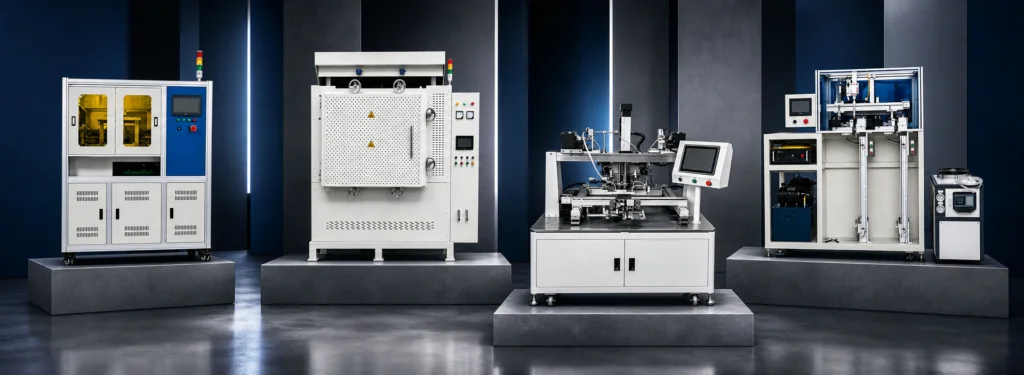
Vapor Chamber Degassing Machine: Process & Selection Guide
1. What Is a Vapor Chamber Degassing Machine?
A vapor chamber degassing machine is industrial equipment designed to help remove unwanted gases from vapor chamber components during manufacturing. Depending on the process design, it may evacuate internal cavities, degas working fluids, or support several preparation stages.
A vapor chamber usually contains a sealed metal enclosure, an internal wick structure, and a working fluid. The working fluid absorbs heat, evaporates, moves toward cooler regions, and releases heat through condensation. The wick structure returns the liquid through capillary action.
For this cycle to work efficiently, manufacturers must control the internal environment. Unwanted gases can interfere with vapor movement and reduce effective heat transfer.
A degassing system helps manufacturers manage these risks. However, the exact function depends on the equipment configuration and production sequence.
1.1 Main Functions
A vapor chamber degassing machine may support several manufacturing tasks:
- Removing air and other unwanted gases from internal cavities.
- Reducing gas content in working fluids before filling.
- Supporting vacuum preparation before final sealing.
- Helping improve consistency between production batches.
- Integrating degassing with heating, filling, or other vacuum processes.
Not every machine performs all these functions. Therefore, manufacturers should define the required process before selecting equipment.
1.2 Degassing Is Not the Same as Leak Testing
Degassing removes gases from a component or process material. Leak testing checks whether a component allows unwanted gas or fluid to pass through a boundary.
These operations address different manufacturing risks. A component may pass through an effective degassing process but still contain a leak. Likewise, a leak-free component may retain excessive non-condensable gas if the manufacturing process does not remove it.
For this reason, manufacturers should evaluate degassing, leak testing, and final sealing as separate quality-control activities.
2. Why Degassing Matters in Vapor Chamber Manufacturing
Vapor chambers rely on phase-change heat transfer. Their performance depends on internal geometry, working-fluid behavior, wick properties, and the quality of the sealed environment.
Consequently, uncontrolled gases can create manufacturing and performance problems.
2.1 Non-Condensable Gases Can Reduce Thermal Performance
Non-condensable gases do not condense under the operating conditions in the same way as the working-fluid vapor. They can accumulate in parts of the chamber and interfere with vapor condensation.
As a result, these gases may reduce the effective condensation area. They can also increase thermal resistance and create uneven temperature distribution.
A suitable degassing process helps reduce this risk. Nevertheless, the final result also depends on material cleanliness, fluid purity, evacuation conditions, and sealing quality.
2.2 Degassing Supports More Consistent Vacuum Conditions
Vapor chamber manufacturing often requires controlled evacuation before filling and sealing. However, trapped gas can remain inside small channels, wick structures, and internal cavities.
These areas may release gas slowly during evacuation. Materials can also release adsorbed moisture or gases when heated.
A properly designed degassing process helps address these challenges. For example, controlled heating may accelerate gas release from compatible materials. Vacuum equipment then removes released gases from the process chamber.
Manufacturers must establish suitable temperature and pressure conditions through process validation. Excessive heat may damage components, affect surface treatments, or create unwanted material changes.
2.3 Degassing Helps Improve Production Stability
Consistent internal conditions support repeatable product performance. Therefore, manufacturers should monitor critical process parameters rather than rely on fixed operating assumptions.
Important parameters include:
- Evacuation pressure and pressure stability.
- Process temperature and heating duration.
- Component loading and fixture arrangement.
- Working-fluid preparation requirements.
- Vacuum holding time.
- Filling and sealing sequence.
- Final product inspection results.
By recording these parameters, production teams can identify deviations and improve process control.
3. How a Vapor Chamber Degassing Machine Works
The operating sequence varies by equipment design. A standalone vacuum degassing system differs from an integrated machine that combines evacuation, fluid handling, and filling.
However, most systems follow a series of controlled process stages.
3.1 Step 1: Component Preparation
Operators prepare the vapor chamber shell and internal wick structure before degassing. They may need to clean, dry, inspect, and assemble the relevant components.
Surface contamination can release unwanted gases during later processing. Therefore, cleaning and drying procedures should match the materials and product design.
Operators should also verify that components meet dimensional and cleanliness requirements before loading them into the equipment.
3.2 Step 2: Loading and Chamber Closure
Operators place components into the processing chamber or connect them to a dedicated vacuum fixture. The fixture must provide suitable support without blocking evacuation paths.
Next, the operator closes the chamber and checks the relevant seals and connections. Poor fixture sealing can increase evacuation time and compromise process stability.
For automated production, loading and positioning mechanisms can improve repeatability. However, manufacturers should confirm that automation matches their component dimensions and production volume.
3.3 Step 3: Initial Evacuation
The vacuum system removes air and other gases from the processing chamber. Depending on the machine design, the system may use one or more vacuum pump stages.
Pressure monitoring helps operators evaluate evacuation progress. If pressure stops decreasing, the process may require additional investigation.
Possible causes include leakage, excessive outgassing, unsuitable pump performance, or restrictions in the evacuation path.
3.4 Step 4: Controlled Heating and Degassing
Some degassing processes apply controlled heat to accelerate the release of trapped moisture and gases. Heating can improve process efficiency when the component materials and internal structures tolerate the selected conditions.
The machine must distribute heat appropriately across the workpiece or processing chamber. Temperature variation may cause inconsistent degassing results.
Manufacturers should validate heating profiles for each product family. They should also avoid assuming that higher temperatures always produce better results.
3.5 Step 5: Vacuum Holding and Stabilization
After evacuation and any required heating, the system may maintain vacuum conditions for a specified period. This holding stage allows additional gases to leave the components.
The required duration depends on material properties, internal geometry, loading quantity, temperature, and the target process conditions.
A stable pressure reading provides useful process information. However, pressure stability alone does not prove that every component has reached the required internal condition.
Manufacturers should combine process monitoring with appropriate product validation.
3.6 Step 6: Transfer to Filling and Sealing
After degassing, the component may proceed to working-fluid filling and final sealing. Some systems integrate these stages, while others use separate machines.
Integrated equipment can reduce handling and exposure to ambient air between operations. Nevertheless, the design must prevent contamination and preserve the required process conditions.
The exact sequence depends on the vapor chamber design and manufacturing method. Manufacturers should confirm whether the degassing machine supports their complete process or only component preparation.
4. Key Components of a Degassing System
The configuration of a vapor chamber degassing machine depends on the application. Still, several components commonly determine performance, usability, and process reliability.
4.1 Vacuum Chamber
The vacuum chamber provides the controlled environment for degassing. Its internal dimensions must accommodate the product, fixtures, and any required heating elements.
Manufacturers should consider the maximum workpiece size and loading arrangement. They should also evaluate chamber cleanliness, sealing design, and ease of maintenance.
4.2 Vacuum Pumping System
The pumping system removes gases from the chamber. Its design should match the required operating pressure, chamber volume, outgassing load, and production cycle.
A larger pump does not automatically guarantee a better process. Conductance restrictions, fixture design, leakage, and gas release rates also affect evacuation performance.
Therefore, manufacturers should evaluate the complete vacuum system rather than select pumps based on nominal pumping speed alone.
4.3 Heating System
A heating system may accelerate moisture removal and gas release. Depending on the application, it may use chamber heating or another controlled heating arrangement.
The system should provide appropriate temperature control and repeatability. Temperature sensors should monitor representative locations, especially when component loading varies.
Not every vapor chamber degassing process requires heating. The equipment supplier should recommend a suitable configuration based on the materials and process objectives.
4.4 Pressure and Temperature Monitoring
Sensors provide the information needed to control and evaluate the process. Pressure sensors help track evacuation progress, while temperature sensors monitor heating conditions.
A programmable controller can coordinate pumps, heating elements, valves, and process timing. It can also record key parameters for quality analysis.
For production environments, data logging can help trace process deviations and compare different batches.
4.5 Fixtures and Loading Systems
Fixtures hold components in a repeatable position. Good fixture design allows effective gas removal while protecting delicate internal structures.
For high-volume manufacturing, multiple-part fixtures may increase throughput. However, heavier loading can increase outgassing and extend the evacuation cycle.
Manufacturers should test realistic loading conditions before confirming the final equipment configuration.
5. Vapor Chamber Degassing and Vacuum Filling
Degassing and vacuum filling are closely related, but they serve different purposes. Understanding this distinction helps manufacturers plan the correct production sequence.
5.1 What Degassing Does
Degassing focuses on removing unwanted gases from a component, working fluid, or processing environment. The objective is to prepare the vapor chamber for subsequent manufacturing stages.
Depending on the process, degassing may occur before fluid filling, during fluid preparation, or within an integrated vacuum operation.
5.2 What Vacuum Filling Does
Vacuum filling introduces a controlled amount of working fluid into the vapor chamber. The equipment must deliver the required fluid quantity while limiting unwanted air entry and contamination.
The fluid quantity depends on the chamber design, wick structure, internal volume, and intended operating conditions. Manufacturers should establish filling parameters through engineering validation.
5.3 Why Process Integration Matters
A poorly coordinated process can allow air or moisture to enter after degassing. This can reduce the benefits of earlier preparation.
Therefore, manufacturers should review the complete sequence from cleaning through filling and sealing. They should also consider transfer time, fixture interfaces, fluid handling, and environmental controls.
An integrated Vapor Chamber Vacuum Filling & Welding Machine may help coordinate several operations. However, manufacturers should verify which functions the proposed system actually includes.
For related equipment, consider internal-link opportunities to the Vapor Chamber Vacuum Filling & Welding Machine and Ultra-thin Vapor Chamber Laser Sealing Machine pages, if available on the company website.
6. Factors That Affect Degassing Performance
A reliable degassing process depends on more than the vacuum pump. Manufacturers should evaluate several interacting factors.
6.1 Internal Geometry
Thin vapor chambers often contain narrow channels and complex wick structures. These features can restrict gas movement and make evacuation more demanding.
The process must allow trapped gases to reach the evacuation path. Fixture openings and component orientation may therefore affect the results.
6.2 Material Cleanliness
Residues, oils, particles, and moisture can contribute to outgassing. Even a capable vacuum system may struggle when components carry excessive contamination.
Manufacturers should establish suitable cleaning, rinsing, drying, and handling procedures. They should also control contamination introduced during assembly and transfer.
6.3 Temperature
Temperature affects the rate at which moisture and adsorbed gases leave a surface. However, the appropriate profile depends on material compatibility and product construction.
A validated temperature profile balances gas removal, cycle time, and component protection. It should not rely on the assumption that maximum heat provides maximum benefit.
6.4 Vacuum Level and Pumping Conductance
The target pressure depends on the product design and process requirements. Manufacturers should define measurable acceptance criteria rather than specify vacuum performance vaguely.
Pumping conductance also matters. Narrow tubing, restrictive valves, and poorly designed fixtures can limit effective pumping speed at the workpiece.
Consequently, the pressure measured near the pump may differ from conditions inside a complex component or fixture.
6.5 Cycle Time and Loading Quantity
Longer cycles may improve degassing in some applications. However, excessive cycle time can reduce production capacity without providing meaningful additional benefits.
Similarly, increasing the number of components per batch may improve throughput but also increase the gas load.
Manufacturers should test different loading quantities and cycle settings. They can then identify a suitable balance between quality and productivity.
7. Applications in Thermal Management Manufacturing
A vapor chamber degassing machine supports production workflows for several thermal management applications.
7.1 CPU and GPU Cooling
Processors generate concentrated heat within small areas. Vapor chambers can spread this heat across a larger surface before heat moves into the cooling assembly.
Degassing helps manufacturers control unwanted gases that may interfere with the phase-change process. Consistent manufacturing conditions are especially important for products designed for demanding thermal loads.
7.2 High-Power Electronics
Power modules, converters, and related electronics require effective heat spreading. Vapor chambers can support compact cooling designs where conventional heat spreaders may face limitations.
A controlled degassing process helps manufacturers prepare internal cavities for filling and sealing. However, final thermal performance also depends on the chamber geometry, wick design, materials, and assembly quality.
7.3 Telecommunications Equipment
Network equipment and communication hardware often operate continuously. Their cooling assemblies must manage heat within restricted installation spaces.
Manufacturers can use controlled degassing processes to improve consistency across production batches. They should still validate the finished vapor chamber under application-specific thermal conditions.
7.4 Compact Consumer Electronics
Thin vapor chambers can support thermal management in compact devices. These products may require precise control of thickness, internal structure, and working-fluid quantity.
Because internal spaces are limited, manufacturing processes must suit the specific design. Degassing parameters should therefore reflect product dimensions and construction.
8. How to Choose the Right Vapor Chamber Degassing Machine
Selecting equipment begins with a clear definition of the production process. Manufacturers should consider current requirements and likely future product changes.
8.1 Define the Required Process
First, determine whether the equipment must degas empty shells, assembled vapor chambers, working fluids, or several of these items.
This distinction affects chamber design, pumping arrangements, heating requirements, and integration options. It also helps prevent purchasing a machine that cannot support the intended process.
8.2 Confirm Product Dimensions and Capacity
Provide the equipment supplier with representative product drawings and loading information. Include the maximum dimensions, component count per batch, and fixture requirements.
The supplier can then evaluate the chamber size and loading configuration. Actual throughput should be confirmed through a representative production test.
8.3 Establish Vacuum and Temperature Requirements
Define the required pressure range, temperature profile, holding time, and process acceptance criteria. Avoid selecting equipment based only on general claims such as “high vacuum” or “fast degassing.”
Where possible, request test data from representative components. The test should reflect the intended loading arrangement and production sequence.
8.4 Evaluate Automation and Traceability
Automation can improve repeatability and reduce operator workload. Depending on production needs, the system may include recipe management, interlocks, alarms, and data logging.
Traceability becomes especially valuable when manufacturers produce multiple models. Recorded process parameters help teams investigate deviations and maintain consistent production practices.
8.5 Consider Integration with Existing Equipment
The degassing machine should fit the broader manufacturing line. Review its interfaces with cleaning equipment, vacuum filling systems, sealing machines, and inspection stations.
For example, a factory may connect degassing with a dedicated filling and welding process. Another factory may prefer separate stations to support flexible production.
The best choice depends on product variety, throughput, available floor space, and investment priorities.
8.6 Assess Supplier Engineering Support
Ask the supplier to explain the machine’s working principle and proposed process sequence. Request a clear list of included functions, optional features, and operating requirements.
Also discuss commissioning, operator training, maintenance access, and spare parts. These factors affect long-term equipment usability.
For customized systems, manufacturers should provide drawings and process information early. This helps the supplier assess technical feasibility before finalizing the design.
9. Common Degassing Problems and Solutions
Even a well-designed system requires proper setup and maintenance. The following issues can affect process consistency.
9.1 Vacuum Pressure Stops Decreasing
This problem may indicate leakage, excessive outgassing, restricted pumping paths, or insufficient pumping capacity.
First, inspect chamber seals and vacuum connections. Next, check the loading arrangement and review pressure trends.
If the system remains unstable, evaluate pump condition and sensor performance. A structured troubleshooting process is more effective than increasing cycle time without identifying the cause.
9.2 Degassing Results Vary Between Batches
Batch variation may result from inconsistent cleaning, different loading quantities, uneven heating, or changes in component materials.
To address this issue, standardize preparation and loading procedures. Record critical parameters and compare successful batches with out-of-specification results.
Manufacturers should also validate fixtures and temperature distribution under realistic production conditions.
9.3 The Process Takes Too Long
Slow evacuation can reduce production capacity. However, simply installing a larger pump may not solve the underlying problem.
Review chamber volume, gas load, fixture conductance, seal condition, and heating requirements. Then test process adjustments under controlled conditions.
A well-optimized process removes unnecessary delays while preserving the required product quality.
9.4 Thermal Performance Remains Inconsistent
Degassing is only one factor affecting finished vapor chamber performance. Other causes may include incorrect fluid quantity, wick defects, internal contamination, poor sealing, or unsuitable chamber geometry.
Therefore, manufacturers should investigate the complete production process. Thermal testing, leak testing, dimensional inspection, and process records can help isolate the cause.
10. Maintenance and Process Optimization
Routine maintenance helps preserve equipment performance and reduce unexpected downtime.
10.1 Inspect Vacuum Seals and Connections
Check chamber seals, fittings, valves, and vacuum lines according to the maintenance schedule. Replace damaged components when necessary.
Small leaks can increase evacuation time and create inconsistent process conditions. Regular inspections help identify these issues early.
10.2 Maintain the Vacuum Pump
Follow the pump manufacturer’s recommendations for servicing and consumables. The maintenance schedule depends on pump type, operating conditions, and the gases handled.
Operators should record maintenance activities and monitor changes in evacuation behavior. A gradual decline in performance may indicate a developing equipment issue.
10.3 Verify Sensor Accuracy
Pressure and temperature measurements guide process control. Therefore, sensor accuracy and calibration status matter.
Establish an appropriate verification schedule based on production requirements. Investigate unexplained measurement changes before adjusting process settings.
10.4 Standardize Recipes
Different vapor chamber models may require different process recipes. Record the approved settings for each product family.
A recipe may include temperature, pressure limits, holding time, valve sequence, and relevant alarm conditions. Controlled recipe management reduces the risk of accidental parameter changes.
10.5 Review Production Data
Use recorded process data to identify recurring delays and deviations. Compare cycle time, pressure trends, loading quantity, and quality results.
This approach supports evidence-based optimization. It also helps manufacturers determine whether a process change improves throughput without reducing product reliability.
11. Frequently Asked Questions
11.1 What Does a Vapor Chamber Degassing Machine Do?
A vapor chamber degassing machine removes unwanted gases from components, working fluids, or a processing environment. Its exact function depends on the equipment configuration. Manufacturers use degassing to support controlled vacuum preparation and consistent production.
11.2 Why Is Degassing Important for Vapor Chambers?
Unwanted gases can interfere with vapor condensation and reduce effective heat transfer. Degassing helps limit this risk when combined with proper cleaning, filling, sealing, and inspection processes.
11.3 Is Degassing the Same as Vacuum Filling?
No. Degassing removes unwanted gases, while vacuum filling introduces a controlled amount of working fluid. Some machines integrate these operations, but others perform them separately.
11.4 Does Every Vapor Chamber Require Heating During Degassing?
Not necessarily. Heating may accelerate moisture removal and gas release, but the process depends on the materials and product design. Manufacturers should validate the temperature profile before production use.
11.5 Can a Degassing Machine Guarantee Vapor Chamber Performance?
No. Degassing supports process control, but it cannot guarantee the finished product’s thermal performance by itself. Wick structure, working-fluid quantity, internal cleanliness, sealing quality, and chamber design also matter.
11.6 How Can Manufacturers Reduce Degassing Cycle Time?
Manufacturers can review pump performance, fixture conductance, loading quantity, cleaning procedures, and heating profiles. They should test each change against product-quality requirements before adopting it.
11.7 Can a Degassing Machine Integrate with a Vapor Chamber Production Line?
Yes, depending on the equipment design. A system may connect with vacuum filling, laser sealing, and inspection equipment. Manufacturers should confirm process interfaces and automation requirements with the equipment supplier.
11.8 What Information Should Buyers Provide When Requesting a Quotation?
Buyers should provide product dimensions, drawings, materials, internal structure details, target process conditions, batch size, and expected production volume. They should also explain whether they need standalone degassing or an integrated vacuum process.
12. Conclusion
A vapor chamber degassing machine helps manufacturers control unwanted gases during vapor chamber production. When correctly configured, it supports stable vacuum preparation and more consistent manufacturing conditions.
However, successful degassing depends on the complete process. Component cleanliness, internal geometry, heating, pumping conductance, working-fluid preparation, and final sealing all influence the result.
Manufacturers should therefore define process requirements before selecting equipment. They should also validate the machine with representative products and realistic production conditions.
For manufacturers developing or upgrading thermal management production lines, cncooling-thermal can serve as a starting point for exploring relevant equipment and manufacturing solutions. Visit https://cncooling-thermal.com/ to review the company’s available information and identify suitable equipment categories.