
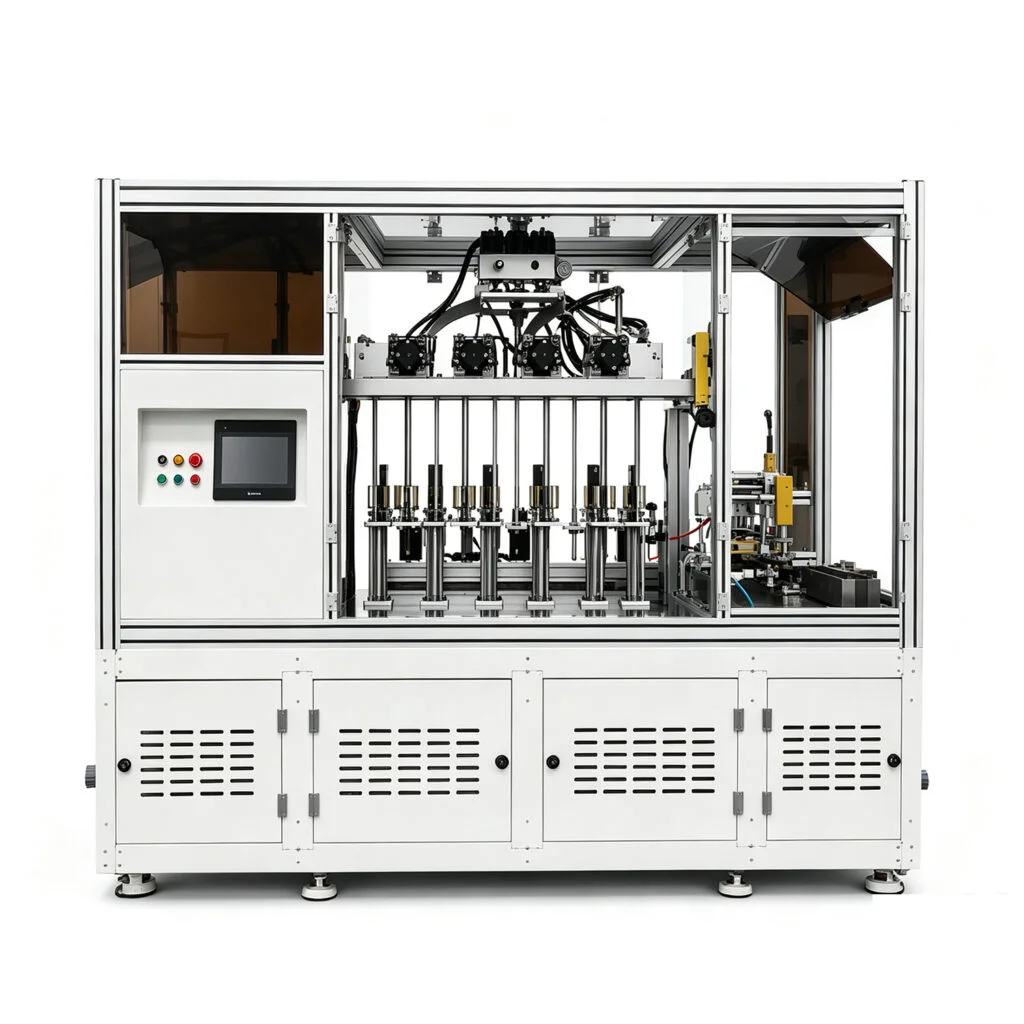
Copper Heat Pipe Bending Machine: Complete Guide
1. What Is a Copper Heat Pipe Bending Machine?
A Copper Heat Pipe Bending Machine forms copper heat pipes into specific curved shapes. It helps manufacturers meet the installation requirements of thermal management products.
Copper heat pipes transfer heat through evaporation and condensation. Their internal wick structure returns liquid toward the evaporator section.
Many cooling assemblies require curved heat pipes. These shapes help connect heat sources with available cooling spaces.
For example, laptop cooling modules often use compact heat pipe arrangements. Graphics cards also require carefully shaped thermal components.
However, bending a heat pipe involves more than changing its external shape. The process must protect its internal structure and sealed working environment.
Excessive deformation can restrict vapor movement. It can also damage the wick and affect liquid return.
A suitable Copper Heat Pipe Bending Machine provides controlled forming operations. Its tooling and process settings should match the product design.
Depending on production requirements, manufacturers may select manual, semi-automatic, or automatic equipment.
The right configuration depends on tube dimensions, bend geometry, production volume, and quality requirements.
2. Why Is Precision Bending Important?
Precision bending affects both product geometry and thermal performance. Therefore, manufacturers must control the forming process carefully.
2.1 Protecting the Internal Wick Structure
A heat pipe usually contains a wick structure. Common designs include sintered powder, mesh, and grooved structures.
The wick supports liquid return during operation. Severe bending can deform its pores or interrupt liquid movement.
Therefore, suitable tooling should limit unnecessary internal deformation. Manufacturers should also validate the bending process using actual products.
2.2 Maintaining the Vapor Channel
The vapor core provides space for vapor movement. Excessive bending can reduce its cross-sectional area.
This restriction may increase flow resistance. It can also influence the heat pipe’s operating limits.
A controlled bending process helps preserve the intended internal geometry.
2.3 Maintaining the Sealed Structure
Many copper heat pipes contain working fluid under vacuum conditions. Their sealed structure must remain intact after forming.
Poor tooling or excessive forming force may damage the tube. Therefore, manufacturers should inspect finished products for leakage.
2.4 Achieving Accurate Installation Dimensions
Thermal assemblies often have limited installation space. Even small dimensional differences can affect assembly.
A suitable bending machine helps produce repeatable shapes. It also supports consistent bend angles and positions.
2.5 Supporting Thermal Performance
Bending can influence thermal resistance and maximum heat transfer capacity. The effect depends on the wick, tube dimensions, bend radius, and angle.
Therefore, manufacturers should not assume every bend produces identical results. Thermal testing should verify the final product design.
3. How Does a Copper Heat Pipe Bending Machine Work?
A Copper Heat Pipe Bending Machine uses controlled mechanical movement to form a heat pipe.
Its operating sequence depends on the machine configuration. However, a typical process includes several stages.
Step 1: Workpiece Preparation
First, operators prepare the heat pipe for bending. They check its dimensions and surface condition.
The manufacturing process may already include filling and sealing. Some product designs may follow a different forming sequence.
Manufacturers should define the correct sequence before production.
Step 2: Workpiece Positioning
Operators place the heat pipe into a suitable fixture. The fixture aligns the required bending position.
Correct positioning helps control bend location. It also reduces unwanted movement during forming.
Step 3: Tooling Engagement
The machine brings the bending tooling into contact with the pipe. The tooling supports the workpiece during deformation.
Depending on the design, the system may use a bending die, clamp, mandrel, or support block.
Each component must match the product geometry.
Step 4: Controlled Bending
The machine applies controlled force and movement. The bending mechanism follows the required angle and radius.
Servo-driven systems can support programmable movement. Mechanical systems may use fixed tooling and controlled operation.
The suitable method depends on product requirements.
Step 5: Shape Release
After bending, the machine releases the workpiece. Operators remove the formed heat pipe for inspection.
The final shape should match the approved product drawing.
Step 6: Dimensional and Quality Inspection
Manufacturers inspect the bend angle, radius, and overall geometry. They should also check for dents, cracks, kinks, and excessive flattening.
Thermal performance and leakage tests may follow. These checks help verify product quality after forming.
4. Main Components of Bending Equipment
Machine structures vary by manufacturer and application. However, several components commonly support heat pipe bending.
4.1 Bending Die
The bending die guides the pipe during forming. Its profile determines important geometric characteristics.
Die selection depends on pipe diameter and bend radius. Manufacturers should also consider the required surface finish.
4.2 Clamping System
The clamping system holds the workpiece in position. Stable clamping helps prevent slipping during bending.
However, excessive clamping force can damage thin copper tubes. Therefore, manufacturers should validate suitable settings.
4.3 Mandrel or Internal Support
Some bending processes use internal support. A mandrel can help limit cross-sectional collapse.
Its suitability depends on the pipe structure and dimensions. The tooling must also accommodate the internal design.
4.4 Driving Mechanism
The driving mechanism produces bending movement. It may use servo motors, pneumatic systems, hydraulic systems, or mechanical transmission.
Different systems offer different control characteristics. Buyers should evaluate the required movement and production speed.
4.5 Positioning and Control System
The control system manages machine movement. It may support angle settings and repeatable operating cycles.
Advanced configurations can include programmable product settings. These functions help manufacturers manage different models.
4.6 Safety Protection
Bending equipment should include suitable safety measures. Guards and emergency stops help protect operators.
The machine layout should also support safe loading and unloading. Manufacturers should follow applicable workplace safety requirements.
5. Common Copper Heat Pipe Bending Methods
Different products require different bending approaches. The suitable method depends on geometry and production conditions.
5.1 Manual Bending
Manual bending uses hand tools or simple fixtures. It may suit prototypes and small production quantities.
However, results depend heavily on operator skill. Repeatability can also become difficult across large batches.
Manufacturers should use suitable forming tools. They should avoid uncontrolled bending by hand.
5.2 Mechanical Bending
Mechanical systems use a driven mechanism to form the pipe. They can provide more consistent movement than manual methods.
This approach may suit stable product designs. Tooling changes may be necessary for different dimensions.
5.3 CNC Servo Bending
CNC servo systems use programmable movement. Operators can configure bending positions and angles.
This method can support multiple product models. It may also simplify repeat production.
However, the machine must match the required forming range. Buyers should verify its actual capabilities.
5.4 Mandrel-Assisted Bending
Mandrel-assisted bending provides additional support during forming. It can help reduce cross-sectional deformation in suitable applications.
However, mandrel design requires careful evaluation. The internal wick structure and tube geometry remain important.
5.5 Custom-Tooling Bending
Some heat pipes require special shapes or multiple bends. Custom tooling can support these product-specific requirements.
Manufacturers should provide drawings and samples. These materials help determine suitable tooling arrangements.
6. Key Factors Affecting Bending Quality
Bending quality depends on several connected factors. Manufacturers should evaluate them together.
6.1 Tube Diameter and Wall Thickness
Tube dimensions influence forming behavior. Thin-wall pipes may require more careful support.
Larger diameters may need different tooling. Therefore, machine selection should start with actual product dimensions.
6.2 Bend Radius
Bend radius strongly influences deformation. A tighter radius can increase local strain.
Many heat pipe design guides use a radius above three times the outside diameter as a typical starting guideline. However, this is not a universal limit.
The suitable radius depends on the wick structure and tube construction. Manufacturers should validate the design through testing.
6.3 Bend Angle
Different applications require different bend angles. Common designs may include 45-degree, 90-degree, or more complex bends.
Increasing deformation can influence internal flow paths. Therefore, each product design requires appropriate validation.
6.4 Wick Structure
Sintered, mesh, and grooved wicks respond differently to bending. Their internal structures have different mechanical characteristics.
Manufacturers should identify the wick type before tooling design. They should also evaluate the finished product’s thermal performance.
6.5 Tooling Clearance
Tooling clearance affects workpiece support. Incorrect clearance can create dents or unwanted flattening.
Suitable tooling should match the pipe diameter. It should also accommodate the required bend geometry.
6.6 Bending Speed and Force
Excessive force can damage the pipe. Uncontrolled movement may also produce inconsistent shapes.
Manufacturers should establish suitable process settings. Sample testing can help identify appropriate parameters.
6.7 Product Inspection
External dimensions alone cannot confirm thermal performance. Internal deformation may remain invisible.
Therefore, manufacturers should combine dimensional inspection with suitable performance tests. Leakage checks are also important for sealed heat pipes.
7. How to Select the Right Bending Machine
Choosing a Copper Heat Pipe Bending Machine requires clear product information.
Buyers should evaluate the following factors before purchasing.
7.1 Confirm Product Dimensions
Prepare the pipe diameter, length, and wall thickness. Include product drawings and representative samples.
These details help determine machine compatibility. They also support accurate tooling design.
7.2 Define the Required Geometry
Specify bend angles, radii, positions, and the number of bends.
Also, identify any special forming requirements. Complex shapes may need customized tooling.
7.3 Identify the Wick Structure
Explain whether the heat pipe uses a sintered, mesh, or grooved wick.
This information helps suppliers evaluate forming risks. It also supports suitable process development.
7.4 Confirm the Production Sequence
Clarify whether bending occurs before or after filling and sealing. This decision depends on the product design and manufacturing method.
Many production lines bend completed heat pipes. Other processes may use different sequences.
The equipment supplier should review the complete workflow.
7.5 Evaluate Production Volume
Estimate daily output and operating hours. Then, determine the required automation level.
Manual or semi-automatic machines may suit flexible production. Automatic systems may suit repetitive, higher-volume manufacturing.
7.6 Review Changeover Requirements
Some factories produce several heat pipe models. Therefore, tooling replacement and parameter adjustment matter.
Ask how operators change between product specifications. Also, confirm the required setup time.
7.7 Request Sample Bending Tests
Provide representative workpieces for machine evaluation. Ask the supplier to demonstrate the required shapes.
Inspect the finished dimensions and surface condition. Where possible, conduct leakage and thermal performance tests.
7.8 Check Maintenance and Technical Support
Review tooling replacement procedures. Also, confirm spare parts and technical documentation.
Accessible components can simplify maintenance. Clear training materials can support daily operation.
8. Integration with a Heat Pipe Production Line
A bending machine can operate independently or within a complete production line.
Its position depends on the heat pipe design. Manufacturers should coordinate the forming sequence with upstream and downstream processes.
A typical manufacturing workflow may include:
- Copper tube cutting
- Internal cleaning and preparation
- Wick structure installation
- Powder filling and sintering
- Tube forming and preliminary processing
- Vacuum degassing
- Working-fluid filling
- Sealing and welding
- Heat pipe bending
- Flattening, if required
- Leakage inspection
- Thermal performance testing
This sequence represents one possible production arrangement. Actual operations depend on product construction.
For many sealed heat pipe designs, bending follows fluid charging and sealing. This approach forms the completed device into its final installation shape.
However, manufacturers must confirm the appropriate sequence for each design.
Consider these internal-link opportunities:
- Heat Pipe Production Line– Link to the complete heat pipe manufacturing workflow.
- Heat Pipe Equipment Production Line– Link to integrated production equipment.
- Heat Pipe Fluid Filling Machine– Link to working-fluid charging equipment.
- Copper Heat Pipe Vacuum Degassing Machine– Link to vacuum preparation equipment.
- Heat Pipe Filling & Welding Machine– Link to combined filling and sealing operations.
- Automatic Heat Pipe Heating Degasser Machine– Link to heating and degassing equipment.
- Heat Pipe Multi-Station Dry-Out Tester– Link to heat pipe process testing equipment.
A coordinated production line can reduce unnecessary handling. It can also improve process consistency and production management.
9. Common Bending Problems and Solutions
Bending problems can affect both appearance and thermal performance. Manufacturers should establish clear inspection procedures.
9.1 Pipe Flattening
The pipe cross-section may become oval during bending. Excessive deformation can also restrict the vapor channel.
Possible solutions:
- Review the bend radius.
- Check die and mandrel compatibility.
- Adjust clamping conditions.
- Improve workpiece support.
- Verify the finished cross-section.
9.2 Kinking or Wrinkling
Sharp bends can create local wrinkles or kinks. Incorrect tooling may also contribute.
Possible solutions:
- Review the tooling profile.
- Check the bending sequence.
- Reduce excessive forming force.
- Evaluate the bend radius.
- Conduct sample trials before production.
9.3 Inaccurate Bend Angles
Incorrect angles can affect assembly dimensions. Positioning errors and inconsistent machine settings may cause this problem.
Possible solutions:
- Check the workpiece fixture.
- Verify angle settings.
- Inspect the driving mechanism.
- Standardize setup procedures.
- Record approved production parameters.
9.4 Surface Scratches and Dents
Tool contact may leave marks on copper surfaces. Contaminated or damaged tooling can make this problem worse.
Possible solutions:
- Inspect the die surface.
- Clean the tooling regularly.
- Check clamping pressure.
- Use suitable contact materials.
- Replace damaged components.
9.5 Thermal Performance Reduction
A bent heat pipe may show changed thermal behavior. Internal wick deformation and vapor channel restriction can contribute.
Possible solutions:
- Review bend geometry.
- Inspect representative samples.
- Compare straight and bent product performance.
- Adjust tooling and forming parameters.
- Validate the final design through thermal testing.
Research has documented how bending and flattening can influence heat pipe performance. The effects depend on deformation and internal structure.
10. Applications of Bent Copper Heat Pipes
Bent copper heat pipes support thermal management in space-constrained products.
Their final geometry helps connect heat sources with cooling surfaces.
10.1 Laptop Cooling Systems
Laptops require compact thermal modules. Bent heat pipes help route heat between processors and cooling fins.
Their shape must match the internal chassis layout. Accurate bending supports efficient assembly.
10.2 Graphics Card Cooling
Graphics cards use heat pipes in many cooling designs. Multiple bends can help connect heat sources with heatsinks.
Manufacturers need repeatable geometry. They should also verify thermal performance after forming.
10.3 LED Lighting
Some LED products use heat pipes for heat transfer. Curved sections can help fit specific lighting structures.
Suitable forming equipment supports consistent product dimensions. It also helps reduce manual adjustment.
10.4 Telecommunications Equipment
Telecommunications devices often have limited installation space. Bent heat pipes can route heat through compact cooling assemblies.
Manufacturers should consider the final mounting arrangement. They should also evaluate the thermal path.
10.5 Industrial Electronic Devices
Industrial electronics may require customized cooling modules. Bent heat pipes can connect components with available cooling areas.
The machine should accommodate the required shape. Product testing should verify the finished assembly.
10.6 Automotive Electronic Systems
Automotive electronic assemblies can contain restricted spaces. Selected designs may use formed heat pipes for thermal management.
Manufacturers should consider vibration and operating conditions. They should also validate the complete thermal assembly.
11. Why Choose cncooling-thermal?
Choosing bending equipment requires more than comparing machine prices. Buyers should evaluate product compatibility and process requirements.
cncooling-thermal focuses on heat pipe and thermal management manufacturing equipment. Its equipment solutions support different stages of heat pipe production.
When discussing a Copper Heat Pipe Bending Machine, prepare the following information:
- Copper heat pipe drawings
- Tube diameter and wall thickness
- Wick structure and product construction
- Required bend angles and radii
- Number and position of bending points
- Expected production volume
- Automation and changeover requirements
- Inspection and thermal performance standards
These details help clarify the required machine configuration. They also support more accurate technical communication.
Visit the official website:
https://cncooling-thermal.com/
Explore related equipment and complete manufacturing solutions through the Heat Pipe Production Line and Heat Pipe Equipment Production Line pages.
12. Frequently Asked Questions
Q1. What Does a Copper Heat Pipe Bending Machine Do?
It forms copper heat pipes into required curved shapes. The equipment supports controlled bending and repeatable product geometry.
Q2. Why Is Special Bending Equipment Necessary?
Heat pipes contain internal wick structures and sealed working environments. Poor bending can damage these structures or affect thermal performance.
Suitable equipment helps control deformation.
Q3. Can a Heat Pipe Be Bent After Filling?
Yes, many manufacturing processes bend heat pipes after fluid charging and sealing. However, the suitable sequence depends on product design and process requirements.
Q4. What Is a Suitable Minimum Bend Radius?
There is no universal minimum radius for every heat pipe. Some design guides use a radius above three times the outside diameter as a starting guideline.
Manufacturers should validate the actual radius with their product structure and thermal requirements.
Q5. Does Bending Affect Heat Pipe Performance?
It can. Excessive deformation may restrict the vapor channel or damage the wick structure.
The actual effect depends on bend geometry and internal construction. Thermal testing should verify the finished product.
Q6. Can One Machine Process Different Pipe Diameters?
Some machines support multiple diameters through tooling changes. Actual compatibility depends on the machine’s design and forming range.
Buyers should confirm the available range before ordering.
Q7. What Shapes Can a Heat Pipe Bending Machine Produce?
Depending on tooling, machines can produce curved sections and different angled configurations. Complex shapes may require customized fixtures and programs.
Product drawings help determine the required configuration.
Q8. How Can Manufacturers Inspect Bent Heat Pipes?
They can inspect bend angles, radii, and cross-sectional deformation. They should also conduct suitable leakage and thermal performance tests.
Advanced inspection methods may help evaluate internal structures.
Q9. Can Bending Equipment Be Integrated into an Automatic Production Line?
Yes, suitable equipment can operate within an automated manufacturing system. Integration depends on handling methods, control requirements, and production sequence.
Q10. What Information Should Buyers Provide?
Provide product drawings, dimensions, bend geometry, wick information, and production targets.
Representative samples can also support equipment evaluation and tooling development.