
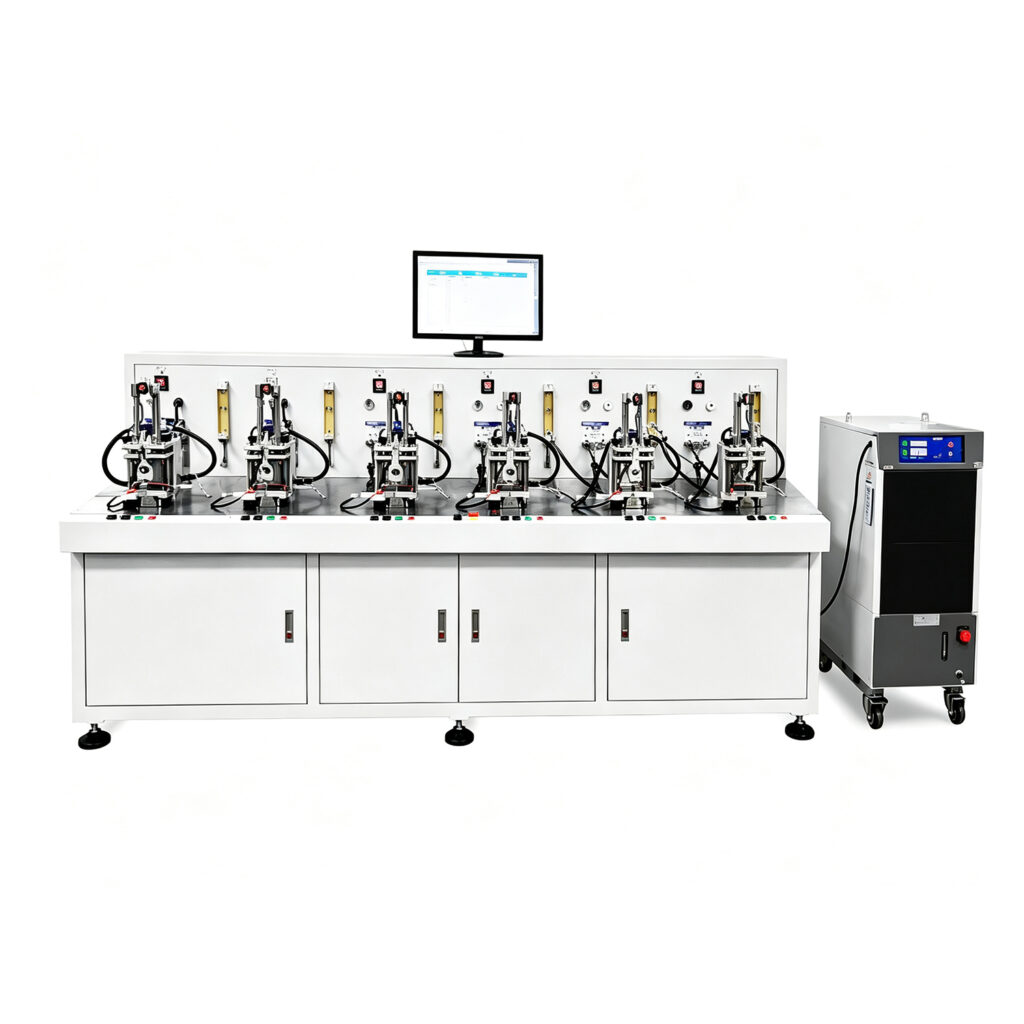
Heat Pipe Production Line: Process and Equipment Guide
1. What Is a Heat Pipe Production Line?
A Heat Pipe Production Line is an integrated manufacturing system for producing heat transfer components. It combines specialized machines and controlled processes.
Heat pipes transfer thermal energy through evaporation and condensation. They offer efficient heat transfer across relatively small structures.
Therefore, manufacturers use heat pipes in many thermal management applications.
Common applications include:
- Consumer electronics cooling
- Computer and server thermal management
- LED lighting systems
- Telecommunications equipment
- Industrial heat transfer systems
- Automotive thermal management
- Power electronics cooling
However, producing reliable heat pipes requires several precise manufacturing operations.
These operations include tube preparation, wick formation, sintering, degassing, working fluid filling, and sealing.
Each stage affects the finished product. Consequently, manufacturers need suitable equipment and consistent process control.
A complete production line can connect these operations into an organized workflow.
The configuration depends on product dimensions, wick structures, materials, and production targets.
For example, a factory producing standard copper-water heat pipes may need different equipment from a factory producing specialized flat heat pipes.
Therefore, manufacturers should define their product requirements before designing the production line.
2. How Does a Heat Pipe Production Line Work?
A typical heat pipe manufacturing system follows a sequence of connected operations.
Each operation prepares the product for the next manufacturing stage.
2.1 Raw Material Preparation
Production begins with suitable metal tubes and other required materials.
Copper is widely used in conventional heat pipe applications. Other materials may support specialized product designs.
Manufacturers should inspect tube dimensions, material quality, and surface conditions.
Consistent raw materials help reduce production variation.
2.2 Tube Cutting and Processing
The cutting machine prepares tubes according to specified dimensions.
Accurate cutting helps maintain product consistency. It also supports reliable downstream processing.
Some designs require additional forming operations. These may include bending, flattening, or necking.
2.3 Wick Structure Formation
The wick structure returns working fluid from the condenser to the evaporator.
Common wick structures include:
- Sintered powder wicks
- Grooved wicks
- Screen mesh wicks
- Composite wick structures
Each structure has different manufacturing requirements.
For example, sintered powder wicks require controlled powder filling and sintering.
Meanwhile, grooved structures require suitable machining or forming processes.
2.4 Vacuum Sintering
For sintered wick designs, manufacturers use a controlled heating process.
A vacuum sintering furnace bonds powder particles together. This creates a porous structure inside the tube.
Temperature, atmosphere, and processing time influence the final result.
Therefore, the sintering process requires suitable equipment and stable parameters.
2.5 Degassing and Fluid Filling
After internal processing, manufacturers remove unwanted gases and moisture.
Next, they introduce the specified working fluid.
The filling quantity depends on the product design and internal volume.
Accurate dosing helps maintain consistent operating conditions.
2.6 Sealing and Welding
Manufacturers seal the heat pipe after filling.
Depending on the product design, the process may use resistance welding or another suitable sealing method.
The sealing operation must provide reliable closure.
Otherwise, leakage may affect product performance and service life.
2.7 Inspection and Testing
The final stage checks product dimensions, appearance, sealing quality, and thermal performance.
Testing requirements depend on the application.
A suitable inspection process helps manufacturers identify defects before shipment.
3. Essential Equipment for Heat Pipe Manufacturing
A complete Heat Pipe Production Line may include several specialized machines.
The required equipment depends on the product structure and manufacturing method.
3.1 Automatic Tube Cutting Machine
The automatic cutting machine prepares metal tubes for further processing.
It helps maintain consistent tube lengths and reduces repetitive manual operations.
Important selection factors include:
- Supported tube materials
- Tube diameter range
- Cutting length range
- Cutting accuracy
- Feeding method
- Production cycle time
Manufacturers should confirm these parameters using their actual tube specifications.
3.2 Heat Pipe Powder Filling Machine
The powder filling machine introduces metal powder into the tube.
It supports the formation of sintered wick structures.
Filling consistency is important because uneven powder distribution can affect wick performance.
An automatic system can improve repeatability and reduce manual handling.
3.3 Vacuum Sintering Furnace
The vacuum sintering furnace creates the porous wick structure.
It uses controlled heating under suitable atmospheric conditions.
Manufacturers should evaluate temperature uniformity, vacuum performance, furnace capacity, and process control.
The correct configuration depends on material characteristics and production requirements.
3.4 Heat Pipe Degassing Machine
The degassing machine removes unwanted gases and moisture.
This process prepares the internal cavity for working fluid filling.
Different production requirements may need different machine configurations.
For example, manufacturers can evaluate primary, secondary, or multi-station vacuum degassing systems.
3.5 Heat Pipe Filling and Welding Machine
This machine performs working fluid filling and sealing operations.
Depending on its configuration, it may integrate vacuum treatment, fluid dosing, and welding.
Accurate filling and reliable sealing are essential for finished product quality.
Manufacturers should confirm the machine’s compatibility with their product design.
3.6 Heat Pipe Necking Machine
The necking machine reduces the diameter of a selected tube section.
This process prepares the tube for subsequent sealing operations.
Suitable tooling helps maintain consistent dimensions.
3.7 Heat Pipe Tail Cutting Machine
The tail cutting machine removes excess tube material.
It helps achieve the required final dimensions and appearance.
A suitable cutting process also supports consistent downstream handling.
3.8 Heat Pipe Multi-Station Dry-Out Tester
A multi-station dry-out tester evaluates heat pipe behavior under defined thermal conditions.
It allows manufacturers to test multiple samples within one operating cycle.
The test method should match the product design and customer requirements.
3.9 Thermal Performance Testing Equipment
Thermal performance testing evaluates heat transfer behavior.
Manufacturers can compare test results against product design targets.
Consistent test conditions are important for meaningful comparisons.
4. Heat Pipe Manufacturing Process Step by Step
The manufacturing sequence depends on the selected wick structure.
However, a typical sintered-wick heat pipe follows the process below.
Step 1: Tube Cutting
First, the cutting machine prepares tubes to the required lengths.
Operators inspect the dimensions and tube ends.
Step 2: Cleaning
Next, manufacturers remove oil, dust, and other contaminants.
Clean internal surfaces support subsequent manufacturing operations.
Step 3: Powder Filling
The powder filling machine introduces metal powder into the tube.
The amount and distribution should match the wick design.
Step 4: Sintering
The tube enters a vacuum sintering furnace.
Controlled heating bonds the powder particles and creates the porous wick.
Step 5: Forming and Processing
Manufacturers perform additional forming operations when required.
These operations may include bending, flattening, or necking.
The process depends on the final heat pipe geometry.
Step 6: Degassing
The degassing system removes unwanted gases and moisture.
This step prepares the internal cavity for fluid filling.
Step 7: Working Fluid Filling
The filling system introduces the specified working fluid.
Manufacturers must control the quantity according to product requirements.
Step 8: Sealing and Welding
The machine seals the tube through a suitable welding process.
Manufacturers then inspect the sealing area.
Step 9: Final Inspection
The finished product undergoes dimensional and appearance checks.
Leak testing and thermal performance testing may follow.
Step 10: Packaging
Qualified products proceed to cleaning, labeling, and packaging.
Packaging requirements depend on transportation and customer specifications.
5. Different Types of Heat Pipe Production Lines
Manufacturers can choose different production line configurations.
The best option depends on output targets, product variety, and investment plans.
5.1 Semi-Automatic Heat Pipe Production Line
A semi-automatic line combines specialized machines with manual operations.
It offers flexibility for manufacturers with changing product specifications.
Its main advantages include:
- Flexible production arrangements
- Easier manual process adjustments
- Lower integration complexity
- Suitability for varied product batches
However, manual handling may increase labor requirements.
It can also introduce greater variation between production batches.
5.2 Fully Automatic Heat Pipe Production Line
A fully automatic line integrates multiple machines and material handling systems.
It reduces manual intervention during repetitive operations.
Depending on the design, the system may include:
- Automatic material feeding
- Automatic positioning
- Integrated machine transfer
- Process monitoring
- Production data collection
- Automatic inspection interfaces
Automation can improve production consistency.
However, manufacturers must confirm machine compatibility before selecting an integrated system.
5.3 Customized Heat Pipe Production Line
Some products require specialized manufacturing arrangements.
For example, flat heat pipes may require different forming and processing equipment.
Special wick structures can also change the powder filling and sintering requirements.
A customized production line addresses these specific needs.
Before finalizing the design, manufacturers should provide product drawings and samples.
The equipment supplier can then evaluate the required processes and machine configuration.
6. Key Factors Affecting Production Efficiency
Production efficiency depends on more than individual machine speed.
Manufacturers should evaluate the entire manufacturing workflow.
6.1 Equipment Capacity Matching
Each machine should support the required production volume.
If one machine operates much slower than others, it may create a bottleneck.
Therefore, manufacturers should compare process cycle times.
6.2 Production Line Layout
A suitable layout reduces unnecessary material movement.
It also improves operator access and equipment maintenance.
Factories should consider material flow before installation.
6.3 Process Parameter Stability
Unstable process parameters can cause quality variation.
For example, sintering conditions influence wick formation.
Filling and welding parameters also affect finished product quality.
Manufacturers should establish clear operating procedures.
6.4 Changeover Time
Factories may produce several heat pipe specifications.
Frequent product changes can reduce effective production time.
Suitable tooling and clear changeover procedures help improve flexibility.
6.5 Preventive Maintenance
Regular maintenance helps keep machines operating reliably.
Manufacturers should establish inspection schedules for critical components.
They should also maintain essential spare parts.
6.6 Operator Training
Operators need to understand machine functions and process requirements.
Training helps reduce operating mistakes.
It also supports safer equipment operation and more consistent production.
7. How to Select the Right Heat Pipe Production Line
Selecting the right production line requires careful technical evaluation.
Manufacturers should compare equipment based on actual production requirements.
7.1 Define Product Specifications
Prepare the basic information before contacting equipment suppliers.
Important details include:
- Heat pipe material
- Tube diameter
- Tube length
- Wall thickness
- Wick structure
- Working fluid
- Product geometry
- Thermal performance requirements
These details help determine the necessary equipment.
7.2 Confirm Production Capacity
Estimate the expected daily and annual output.
Then calculate the required machine cycle times.
Consider planned production growth as well.
A suitable system should meet current requirements and support reasonable expansion.
7.3 Review Equipment Compatibility
Not every machine supports every heat pipe design.
Manufacturers should confirm tooling compatibility and processing ranges.
Provide actual samples when possible.
This allows suppliers to evaluate the manufacturing requirements more accurately.
7.4 Evaluate Automation Levels
Automation should match the production strategy.
A semi-automatic system may suit smaller batches and diverse products.
A fully automatic system may benefit factories with stable, high-volume production.
Consider the total operating cost before deciding.
7.5 Check Supplier Engineering Capabilities
A qualified equipment supplier should understand heat pipe manufacturing processes.
Review its equipment range and technical documentation.
Also evaluate its installation, commissioning, and training support.
7.6 Calculate Total Investment Costs
Machine prices are only one part of the investment.
Manufacturers should also consider:
- Factory preparation
- Installation costs
- Energy consumption
- Labor requirements
- Tooling expenses
- Maintenance costs
- Spare parts
- Future upgrades
A complete cost evaluation supports better purchasing decisions.
8. Quality Control and Performance Testing
Quality control should cover every important manufacturing stage.
It should not begin only after the production process finishes.
8.1 Raw Material Inspection
Inspect tube dimensions and material quality before production.
Check powder materials against the required specifications.
Consistent materials help improve process stability.
8.2 Wick Structure Inspection
The wick structure affects working fluid circulation.
Manufacturers should evaluate its consistency and suitability for the design.
The inspection method depends on the selected wick structure.
8.3 Sintering Process Monitoring
Monitor relevant furnace parameters throughout sintering.
Temperature and atmospheric conditions influence the porous structure.
Maintain process records for quality traceability.
8.4 Filling Accuracy
The working fluid quantity must match the product design.
Manufacturers should monitor the filling process and verify dosing consistency.
8.5 Sealing and Leakage Inspection
Inspect the sealing area after welding.
Apply suitable leakage tests according to product requirements.
Reliable sealing helps maintain the internal operating environment.
8.6 Thermal Performance Testing
Thermal performance testing evaluates the finished heat pipe.
Test conditions should remain consistent between samples.
Depending on the product, relevant conditions may include heating power, cooling conditions, orientation, and measurement locations.
9. Common Manufacturing Problems and Solutions
Manufacturers may encounter process problems during heat pipe production.
The following table summarizes common issues and possible corrective actions.
Common problem | Possible reason | Suggested solution |
Uneven wick structure | Inconsistent powder distribution | Review powder filling and material specifications |
Poor sintering results | Unstable furnace conditions | Check temperature and atmospheric control |
Residual internal gases | Incomplete degassing | Review vacuum conditions and cycle time |
Incorrect fluid quantity | Unstable dosing | Check and calibrate the filling system |
Sealing leakage | Unsuitable welding parameters | Review positioning and welding conditions |
Inconsistent thermal results | Production or testing variation | Standardize processes and test conditions |
Low production efficiency | Poor equipment coordination | Review cycle times and material flow |
9.1 Uneven Wick Formation
Uneven powder distribution can affect capillary performance.
Manufacturers should check powder quality and filling consistency.
They should also verify whether the tooling matches the tube dimensions.
9.2 Incomplete Degassing
Residual gases can affect internal operating conditions.
Manufacturers should review vacuum performance and process duration.
Suitable maintenance also helps keep the system operating consistently.
9.3 Unstable Welding Quality
Welding problems may result from incorrect parameters or poor positioning.
Regular inspection of electrodes and fixtures can help.
Manufacturers should also establish clear sealing inspection procedures.
9.4 Inconsistent Thermal Performance
Thermal performance variation may result from manufacturing differences.
It may also come from inconsistent testing conditions.
Review the wick structure, fluid quantity, sealing quality, and test procedure.
10. Frequently Asked Questions
10.1 What Is a Heat Pipe Production Line?
A Heat Pipe Production Line is a manufacturing system for producing heat pipes.
It may include cutting, cleaning, powder filling, sintering, degassing, fluid filling, welding, and testing equipment.
Its configuration depends on product design and production requirements.
10.2 What Equipment Is Required to Manufacture Heat Pipes?
Common equipment includes automatic cutting machines and powder filling machines.
Manufacturers may also need vacuum sintering furnaces, degassing machines, and filling and welding equipment.
Testing equipment supports final quality inspection.
10.3 What Is the Most Important Machine in a Heat Pipe Production Line?
There is no single machine that determines overall product quality.
The powder filling, sintering, degassing, filling, and sealing processes all matter.
Their importance depends on the heat pipe design.
10.4 Can One Production Line Manufacture Different Heat Pipe Sizes?
Some production lines support multiple sizes through adjustable tooling.
However, the supported range depends on machine design.
Manufacturers should confirm the required dimensions before purchasing equipment.
10.5 What Is the Purpose of a Vacuum Sintering Furnace?
A vacuum sintering furnace bonds metal powder particles into a porous wick structure.
This structure helps transport working fluid through capillary action.
The process requires suitable temperature and atmospheric conditions.
10.6 Why Does Heat Pipe Manufacturing Require Degassing?
Degassing removes unwanted gases and moisture from the internal cavity.
It prepares the heat pipe for working fluid filling.
Controlled degassing supports consistent internal conditions.
10.7 How Does Automation Improve Heat Pipe Production?
Automation reduces repetitive manual operations.
It can improve material handling and process consistency.
Integrated systems may also support production monitoring and data collection.
10.8 How Can Manufacturers Choose a Suitable Equipment Supplier?
Manufacturers should review the supplier’s technical capabilities and equipment range.
They should provide product drawings, samples, and production targets.
Then they can request a configuration based on actual manufacturing requirements.
10.9 Can a Heat Pipe Production Line Be Customized?
Yes. Manufacturers can customize the equipment configuration around their products.
Customization may involve machine selection, tooling, material handling, and automation.
The supplier should first review the product structure and manufacturing process.
11. Conclusion
A well-designed Heat Pipe Production Line helps manufacturers organize production processes and improve manufacturing consistency.
The right equipment configuration depends on product dimensions, wick structures, and output requirements.
Manufacturers should evaluate every production stage before making an investment.
They should also consider automation, quality control, maintenance, and technical support.
For heat pipe manufacturing equipment and production solutions, visit cncooling-thermal.
A carefully planned production system can support stable manufacturing and long-term business development.