
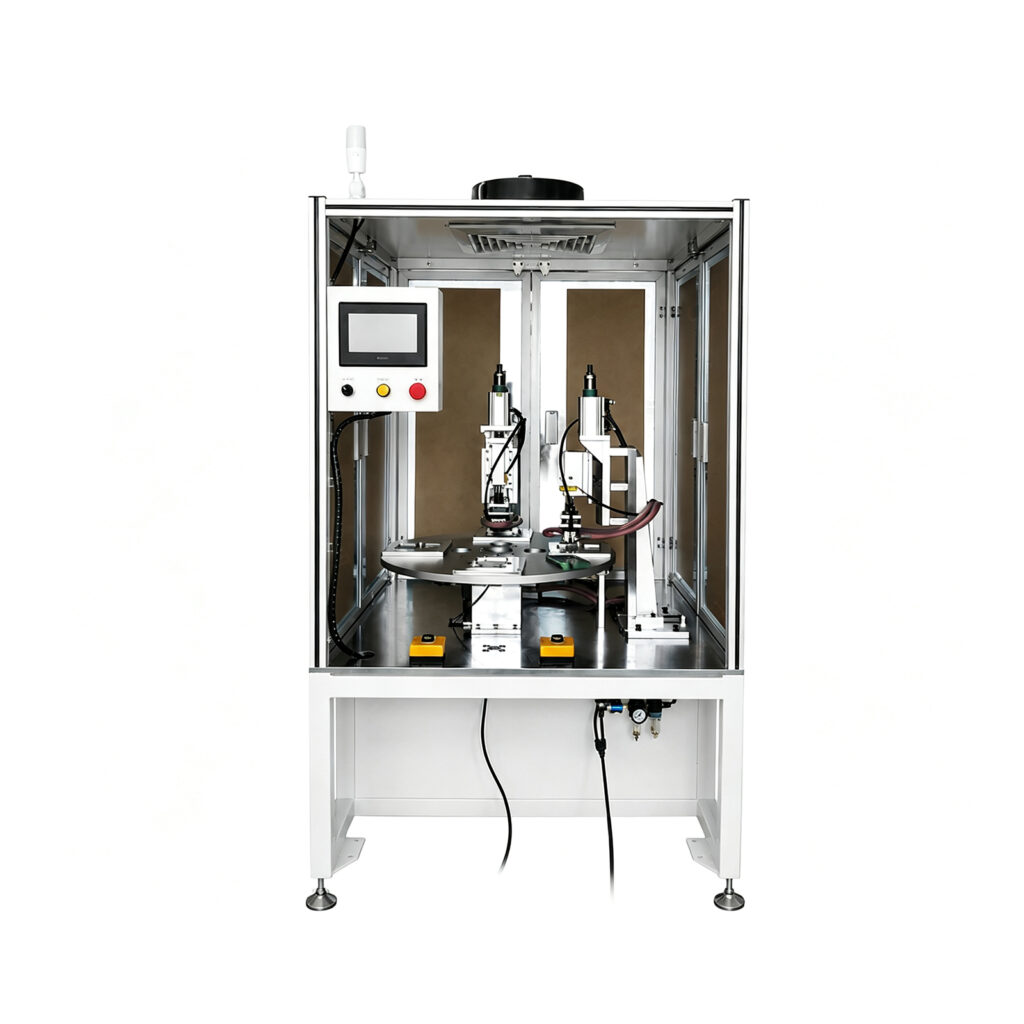
Vapor Chamber Fully Automatic Laser Sealing Machine Guide
1. What Is a Vapor Chamber Fully Automatic Laser Sealing Machine?
A Vapor Chamber Fully Automatic Laser Sealing Machine provides precision welding and sealing for compatible vapor chamber manufacturing processes.
Unlike conventional joining methods, laser technology concentrates energy within a small processing area.
Therefore, manufacturers can create precise weld seams while limiting unnecessary heat input.
Furthermore, automatic positioning systems help maintain repeatable welding trajectories.
The machine typically integrates a laser source, motion system, positioning fixtures, control interface, and safety enclosure.
Additionally, some configurations include vision positioning, automatic loading, and weld monitoring systems.
Consequently, manufacturers can improve production consistency while reducing repetitive manual operations.
Main Functions
An automatic laser sealing system can support several manufacturing tasks:
- Precision welding of copper vapor chamber components
- Automatic positioning and alignment
- Controlled laser welding paths
- Sealing of compatible filling ports
- Programmable welding parameter management
- Automated component handling
- Production process monitoring
- Integration with inspection equipment
However, machine functions depend on the specific configuration and vapor chamber design.
Therefore, manufacturers should confirm equipment compatibility before selecting a system.
2. How Does a Vapor Chamber Laser Sealing Machine Work?
A laser sealing machine uses concentrated optical energy to join metal surfaces.
First, the positioning system secures the vapor chamber within a precision fixture.
Next, the control system identifies the required welding trajectory.
Then, the laser source directs energy toward the target joint.
Consequently, the copper material absorbs sufficient energy to create a localized molten region.
As the laser moves along the welding path, the molten material solidifies into a continuous joint.
Furthermore, suitable shielding and process controls help maintain weld quality.
Finally, the system completes the welding cycle and releases the component.
Additionally, manufacturers can connect the machine to other production equipment through compatible automation interfaces.
Therefore, automatic laser sealing supports integrated vapor chamber manufacturing workflows.
3. Main Components of Automatic Laser Sealing Equipment
A modern laser sealing system combines several precision components.
Furthermore, each component contributes to welding accuracy, reliability, and production efficiency.
3.1 Laser Source
The laser source generates concentrated optical energy for welding operations.
For example, manufacturers commonly consider fiber laser technology for industrial metal welding.
However, copper presents challenges because its optical absorption and thermal conductivity depend on processing conditions.
Therefore, laser wavelength, power, beam quality, and pulse characteristics require careful selection.
3.2 Precision Motion System
The motion system controls the position of the laser beam or workpiece.
Additionally, servo motors and precision guides support repeatable movement.
Consequently, the machine can follow programmed welding trajectories.
3.3 Automatic Positioning System
Precision positioning fixtures hold vapor chamber components during welding.
Furthermore, suitable clamping helps maintain consistent joint alignment.
Therefore, manufacturers can reduce dimensional variation during production.
3.4 Industrial Control System
A programmable control system coordinates machine operations.
For example, operators can configure welding speed, laser output, and motion sequences.
Additionally, recipe management supports different product specifications.
3.5 Vision Inspection System
Optional machine vision systems identify component positions and alignment conditions.
Consequently, the equipment can compensate for certain positioning variations.
Furthermore, cameras can support inspection before or after welding.
3.6 Safety Protection System
Laser welding requires appropriate safety controls.
Therefore, industrial machines should include suitable enclosures, interlocks, and emergency stops.
Additionally, fume extraction and electrical protection support safer operation.
4. Vapor Chamber Laser Sealing Process
Laser sealing forms an important stage within a vapor chamber production line.
However, the exact sequence depends on the chamber structure and manufacturing method.
Step 1: Material Preparation
First, manufacturers prepare copper chamber components according to product drawings.
Next, cleaning equipment removes surface contamination.
Consequently, clean joint surfaces support more consistent welding.
Step 2: Chamber Assembly
Next, technicians align the upper and lower chamber shells.
Additionally, positioning fixtures maintain the required assembly geometry.
Therefore, the components remain stable during welding.
Step 3: Welding Parameter Configuration
Operators configure suitable welding parameters for the material and joint design.
For example, settings may include laser power, travel speed, focus position, and shielding conditions.
Furthermore, engineers validate these parameters through sample welding.
Step 4: Automatic Laser Welding
The laser system follows the programmed welding trajectory.
Meanwhile, the control system coordinates motion and laser output.
Consequently, the process creates the required joint geometry.
Step 5: Weld Inspection
After welding, inspection equipment checks the seam.
For example, manufacturers may examine surface appearance, dimensions, and potential defects.
Additionally, leak testing verifies hermetic performance when the manufacturing stage permits.
Step 6: Final Sealing
Some vapor chamber designs require additional evacuation and working fluid charging before final closure.
Therefore, manufacturers may perform a separate filling-port sealing operation.
Finally, suitable leak and thermal tests verify the finished component.
5. Key Features of Fully Automatic Laser Sealing Machines
Automatic laser sealing equipment offers several useful manufacturing capabilities.
High-Precision Welding
First, focused laser energy enables accurate processing of suitable joint geometries.
Furthermore, programmable motion systems maintain consistent welding paths.
Consequently, manufacturers can improve welding repeatability.
Automatic Production Control
Industrial control systems coordinate the welding process.
Additionally, stored processing recipes simplify product changeovers.
Therefore, operators can manage different compatible chamber specifications.
Stable Welding Performance
Consistent process parameters help reduce variation between production cycles.
However, material quality and fixture accuracy also influence welding results.
Consequently, manufacturers must control the complete process.
Flexible Equipment Configuration
Different vapor chamber designs require different welding strategies.
Therefore, machine configurations may include adjustable fixtures and programmable motion axes.
Furthermore, suitable automation modules support different production requirements.
Production Data Monitoring
Modern systems may collect welding parameters and operating records.
Additionally, traceability functions support manufacturing quality analysis.
As a result, engineers can identify process deviations more efficiently.
6. Advantages of Laser Sealing Technology
Laser sealing offers several potential advantages over conventional joining technologies.
6.1 Reduced Heat Input
Laser systems concentrate energy within a relatively small area.
Therefore, suitable welding parameters can limit unnecessary heating.
Furthermore, controlled heat input helps protect nearby structures.
6.2 Improved Welding Precision
Automated motion systems follow programmed welding paths.
Consequently, manufacturers can achieve repeatable seam positioning.
6.3 Higher Production Efficiency
Automatic loading and welding reduce repetitive manual operations.
Additionally, suitable multi-station configurations can support higher throughput.
6.4 Improved Process Consistency
Programmable settings support standardized production procedures.
Therefore, manufacturers can reduce variation from manual parameter adjustments.
6.5 Flexible Manufacturing
Laser welding equipment can support different component geometries through suitable tooling and programming.
Consequently, manufacturers can adapt equipment to changing product requirements.
6.6 Better Automation Integration
Industrial laser systems can communicate with other compatible production equipment.
Furthermore, automated transfer systems reduce unnecessary handling.
Therefore, laser sealing technology supports integrated manufacturing solutions.
7. Applications in Vapor Chamber Manufacturing
Vapor chambers support thermal management across multiple electronic industries.
Consequently, reliable sealing equipment remains important for component manufacturing.
AI Servers and Data Centers
AI computing systems generate substantial heat during operation.
Therefore, vapor chambers help spread concentrated thermal loads.
Additionally, precision manufacturing supports consistent cooling component performance.
Graphics Cards
High-performance graphics processors require effective heat distribution.
Consequently, vapor chambers often support advanced GPU cooling assemblies.
Furthermore, reliable manufacturing helps maintain consistent thermal performance.
Laptop Computers
Modern laptops combine compact dimensions with demanding computing requirements.
Therefore, thin vapor chambers support heat spreading within limited spaces.
Additionally, precise sealing helps protect the internal working environment.
Telecommunications Equipment
Communication systems require stable thermal management.
Consequently, vapor chambers can support compact, high-power electronic assemblies.
Industrial Electronics
Industrial electronics operate under varied thermal conditions.
Therefore, manufacturers use advanced heat spreading components where appropriate.
Furthermore, application-specific chamber designs require compatible manufacturing equipment.
8. Laser Sealing vs. Traditional Sealing Methods
Manufacturers use different joining methods for vapor chamber production.
However, each method offers different technical characteristics.
Comparison | Laser Sealing | Conventional Brazing |
Heat input | Localized | Broader heating |
Process control | Precise beam control | Furnace or localized heating control |
Automation | Strong integration potential | Depends on equipment |
Joint requirements | Requires suitable geometry | Requires suitable filler and joint design |
Processing speed | Often fast for suitable seams | Depends on brazing method |
Material compatibility | Depends on laser and parameters | Depends on filler and base materials |
Typical challenges | Reflectivity, porosity, fit-up | Thermal cycles, filler control |
Why Manufacturers Consider Laser Sealing
Laser welding offers localized heating and programmable processing.
Furthermore, suitable automation can improve repeatability.
However, successful copper welding requires careful process development.
Therefore, manufacturers should evaluate sample welds, leakage performance, and long-term reliability before choosing a method.
9. Integration with Vapor Chamber Production Lines
A Vapor Chamber Fully Automatic Laser Sealing Machine can operate within an integrated manufacturing system.
Furthermore, equipment coordination improves production flow and process management.
Related Manufacturing Equipment
Internal Link: Vapor Chamber Production Line
A complete production system coordinates material preparation, wick manufacturing, assembly, sealing, and testing.
Internal Link: Automatic Powder Filling Machine
This equipment distributes copper powder for compatible sintered wick designs.
Internal Link: Vacuum Sintering Furnace
The furnace supports controlled processing of porous wick structures.
Internal Link: Vacuum Degassing Machine
Vacuum processing removes unwanted gases before final chamber closure.
Internal Link: Vapor Chamber Hot Press Hydraulic Machine
Suitable pressing equipment supports forming or flattening operations within validated manufacturing processes.
Internal Link: Multi-Station Thermal Performance Tester
Thermal testing equipment evaluates heat transfer performance across production batches.
Benefits of Integrated Production
First, integrated systems reduce unnecessary material transfers.
Additionally, automation improves coordination between processing stations.
Consequently, manufacturers can reduce handling-related variation.
Furthermore, connected production data supports quality traceability.
Therefore, manufacturers can improve process monitoring and production planning.
10. Key Technical Parameters and Quality Requirements
Machine specifications vary according to the laser source, chamber geometry, and automation configuration.
Therefore, buyers should confirm actual specifications with the equipment supplier.
Parameter | Selection Consideration |
Laser type | Suitable wavelength and laser technology |
Laser power | Match copper thickness and joint geometry |
Welding speed | Determine through process validation |
Positioning accuracy | Match product tolerance requirements |
Supported dimensions | Confirm minimum and maximum chamber sizes |
Automation level | Manual, semi-automatic, or fully automatic |
Cooling system | Match laser and operating requirements |
Control system | Programmable industrial controller |
Inspection functions | Vision, weld monitoring, or leak testing |
Electrical supply | Match factory utility conditions |
Welding Quality Requirements
Reliable vapor chamber welding requires careful control of several factors.
Weld Continuity
The weld seam must maintain the required joint continuity.
Leakage Performance
Hermetic sealing must satisfy the product’s specified leak criteria.
Dimensional Stability
The welding process should maintain acceptable chamber geometry.
Surface Quality
The weld should avoid unacceptable cracks, excessive spatter, and other defects.
Thermal Reliability
The finished chamber must satisfy its thermal performance requirements.
Furthermore, manufacturers should validate process parameters before full-scale production.
11. How to Choose the Right Laser Sealing Machine
Selecting suitable equipment requires a detailed understanding of manufacturing requirements.
First, manufacturers should define their vapor chamber specifications.
Next, they should evaluate machine capabilities and production targets.
Product Dimensions
Determine chamber length, width, thickness, and joint geometry.
Consequently, suppliers can recommend suitable fixtures and motion systems.
Copper Material Characteristics
Copper thickness, surface condition, and material grade influence welding performance.
Therefore, machine selection must consider the actual materials.
Production Capacity
Estimate daily production volume and operating shifts.
Additionally, consider future manufacturing expansion.
Automation Requirements
High-volume production may benefit from automatic handling systems.
Meanwhile, smaller production batches may require greater flexibility.
Quality Inspection
Confirm the required welding inspection and leak testing methods.
Furthermore, request sample validation whenever possible.
Technical Support
Evaluate installation, training, maintenance, and spare-part requirements.
Consequently, manufacturers can reduce operational risks after commissioning.
12. Maintenance and Safety Considerations
Regular maintenance supports stable equipment performance.
Furthermore, appropriate safety procedures protect operators and manufacturing facilities.
Optical System Maintenance
First, inspect protective windows and optical components according to manufacturer instructions.
Additionally, keep optical surfaces free from contamination.
Consequently, the laser system can maintain more consistent processing conditions.
Motion System Inspection
Check guides, drives, fixtures, and positioning components.
Furthermore, follow the recommended lubrication and calibration procedures.
Cooling System Maintenance
Monitor cooling temperature, flow, and fluid condition.
Therefore, the laser system can operate within its specified thermal limits.
Safety System Inspection
Verify protective enclosures, interlocks, emergency stops, and warning indicators.
Additionally, train operators in laser safety procedures.
Welding Process Verification
Perform periodic sample welding and inspection.
Consequently, manufacturers can identify changes in welding quality before they affect larger production batches.
13. Why Choose cncooling-thermal?
cncooling-thermal focuses on thermal manufacturing equipment and related production technologies.
Through https://cncoolingthermal.com/, customers can explore vapor chamber production equipment and manufacturing solutions.
Application-Focused Equipment Selection
Different vapor chamber designs require different manufacturing processes.
Therefore, equipment selection should begin with product drawings and technical requirements.
Manufacturing Process Integration
Laser sealing must coordinate with upstream and downstream operations.
Consequently, integrated planning supports more efficient manufacturing workflows.
Automation-Oriented Solutions
Modern production facilities increasingly require automated equipment.
Furthermore, programmable systems support repeatable manufacturing operations.
Quality-Focused Process Planning
Vapor chamber reliability depends on welding, vacuum processing, charging, and inspection.
Therefore, manufacturers should evaluate complete process requirements.
Equipment Consultation
Customers can contact cncooling-thermal to discuss available machine configurations and project requirements.
Additionally, detailed drawings and production targets support more accurate technical evaluations.
14. Frequently Asked Questions
Q1: What is a Vapor Chamber Fully Automatic Laser Sealing Machine?
It is industrial equipment that uses automated laser welding to seal compatible vapor chamber components.
Furthermore, programmable motion and positioning systems support repeatable welding operations.
Q2: Why is laser sealing important for vapor chambers?
Laser sealing creates precise joints with localized heat input.
Consequently, suitable processes can support reliable hermetic chamber construction.
Q3: Can laser welding equipment process copper vapor chambers?
Yes, suitable laser systems can weld copper components.
However, copper welding requires appropriate laser technology, joint preparation, and validated processing parameters.
Q4: What laser technology works for vapor chamber sealing?
Manufacturers commonly evaluate fiber laser systems and other suitable industrial laser technologies.
Therefore, the final choice depends on copper thickness, joint design, and performance requirements.
Q5: Can the machine support different vapor chamber sizes?
Some machines support multiple product dimensions through adjustable fixtures and programmable motion systems.
However, supported sizes depend on the actual equipment configuration.
Q6: Is laser sealing better than brazing?
Laser sealing offers localized heating and strong automation potential.
However, brazing may suit other joint geometries and manufacturing requirements.
Therefore, manufacturers should compare both methods through process validation.
Q7: Can laser sealing equipment integrate with automatic production lines?
Yes, compatible equipment can connect with automated loading, transfer, and inspection systems.
Consequently, manufacturers can develop coordinated production workflows.
Q8: How can manufacturers verify sealing quality?
Manufacturers can use visual inspection, dimensional measurement, and suitable leak testing methods.
Additionally, thermal performance testing helps evaluate finished chamber functionality.
Q9: What affects the price of automatic laser sealing equipment?
Laser configuration, automation level, positioning accuracy, and inspection features influence equipment cost.
Therefore, buyers should request quotations based on actual manufacturing requirements.
Q10: Where can I learn more about vapor chamber laser sealing equipment?
Visit cncoolingthermal.com to explore related manufacturing technologies.
Furthermore, customers can contact cncooling-thermal to discuss equipment selection and production requirements.
15. Conclusion
A Vapor Chamber Fully Automatic Laser Sealing Machine supports precision manufacturing of advanced thermal management components.
Furthermore, automated laser technology provides programmable welding control and repeatable processing capabilities.
Consequently, manufacturers can improve production consistency through suitable equipment and validated manufacturing procedures.
However, reliable vapor chamber production requires more than accurate welding.
Therefore, manufacturers must coordinate material preparation, wick manufacturing, vacuum processing, fluid charging, and quality inspection.
At cncooling-thermal, we recognize the importance of integrated thermal manufacturing solutions.
Visit https://cncooling-thermal.com/https://cncoolingthermal.com/ to explore vapor chamber manufacturing equipment and related technologies.