
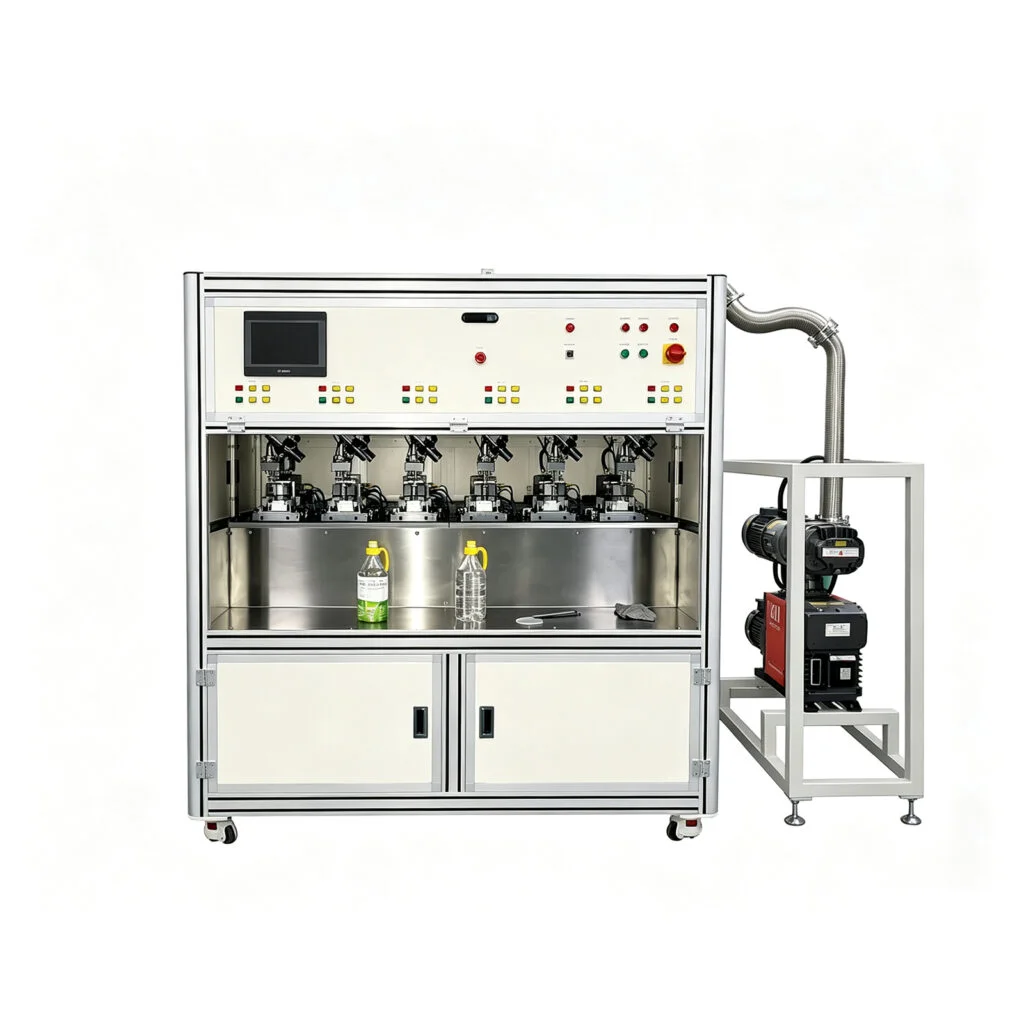
Vapor Chamber Vacuum Filling & Welding Machine Guide
Introduction
A vapor chamber transfers heat through phase changes and internal fluid circulation. Therefore, its manufacturing process requires careful control of evacuation, working fluid charging, and final sealing.
A Vapor Chamber Vacuum Filling & Welding Machine combines these critical operations within a coordinated production system. It helps manufacturers establish repeatable process conditions and reduce unnecessary manual handling.
Furthermore, integrated equipment supports consistent production workflows for thermal management components. These components serve electronics, computing hardware, telecommunications equipment, and other heat-sensitive applications.
However, successful production depends on more than equipment selection. Manufacturers must also control chamber cleanliness, internal structure, working fluid quantity, welding quality, and final inspection.
This guide explains the machine’s operating principles, main components, selection criteria, applications, and quality requirements. It also outlines how manufacturers can evaluate equipment for their production needs.
1. What Is a Vapor Chamber Vacuum Filling & Welding Machine?
A Vapor Chamber Vacuum Filling & Welding Machine is industrial equipment designed to support vapor chamber evacuation, working fluid charging, and filling-port sealing.
A vapor chamber usually contains a sealed metal enclosure, a wick structure, and a working fluid. During operation, the fluid absorbs heat and evaporates in the hotter region. Subsequently, vapor moves toward cooler areas and releases heat through condensation.
The wick structure helps return liquid to the evaporation region. Consequently, the chamber can transfer heat efficiently when its internal design and operating conditions meet application requirements.
However, trapped gases can interfere with the intended internal environment. Incorrect fluid charging can also affect thermal performance. Additionally, poor sealing may cause fluid loss or unwanted leakage.
Therefore, manufacturers need reliable equipment for evacuation, filling, and sealing. An integrated machine can coordinate these operations according to a defined process sequence.
The actual configuration varies with chamber dimensions, materials, filling-port design, production volume, and required automation level. Buyers should confirm these details with the equipment supplier before specifying a machine.
2. Why Vacuum Filling and Welding Matter
2.1 Removing Unwanted Gases
Air and other non-condensable gases can reduce effective heat transfer inside a vapor chamber. These gases may interfere with vapor movement and condensation.
Therefore, manufacturers evacuate the chamber before introducing the working fluid. The required vacuum conditions depend on the product design and validated manufacturing process.
Furthermore, vacuum performance depends on the complete system. Pump capacity, fixture sealing, piping, chamber volume, and evacuation time all influence results.
2.2 Controlling Working Fluid Quantity
Each vapor chamber requires a suitable working fluid quantity for its design. Too little fluid may limit liquid availability within the wick structure.
Conversely, excessive fluid may create undesirable operating conditions. Therefore, manufacturers should establish an appropriate charging range through engineering validation.
A controlled filling system supports repeatable dosing. Additionally, documented filling parameters help manufacturers investigate performance variations.
2.3 Achieving Reliable Sealing
After charging, the filling port must be sealed to preserve the chamber’s internal conditions.
Welding can close the designated port and create a durable metal joint. However, weld quality depends on material compatibility, joint geometry, process parameters, and workpiece positioning.
Consequently, manufacturers should validate the sealing process and establish suitable inspection procedures. Visual inspection alone cannot confirm hermetic integrity.
2.4 Improving Production Consistency
Manual processing may introduce variations in evacuation, charging, and sealing. Separate workstations may also require additional transfers and operator intervention.
An integrated machine coordinates these operations within a defined workflow. Therefore, it can improve process repeatability and support production traceability.
Nevertheless, automation does not eliminate every source of variation. Operators still need suitable fixtures, validated recipes, trained personnel, and effective quality controls.
3. How the Machine Works
A typical Vapor Chamber Vacuum Filling & Welding Machine follows several coordinated processing stages.
The precise sequence depends on the machine configuration and vapor chamber design. Manufacturers should verify the actual process flow before production deployment.
Step 1: Load and Position the Chamber
First, the operator or loading system positions the chamber in a dedicated fixture.
The fixture maintains alignment and provides access to the filling port. Furthermore, secure positioning helps reduce movement during processing.
Step 2: Connect the Vacuum Circuit
Next, the machine establishes a sealed connection between the chamber and the vacuum circuit.
Suitable fixtures and connection seals help minimize unwanted air leakage. Therefore, manufacturers should inspect connection surfaces and sealing components regularly.
Step 3: Evacuate the Chamber
The vacuum system removes air and other unwanted gases from the chamber.
Pressure monitoring helps determine whether the process reaches its specified conditions. Additionally, the control system can manage the evacuation sequence according to the selected recipe.
However, a pressure reading alone does not establish complete internal cleanliness. Manufacturers should validate evacuation conditions against the chamber design and process requirements.
Step 4: Introduce the Working Fluid
After the required evacuation stage, the filling system introduces the specified working fluid.
A suitable metering arrangement helps maintain consistent charging quantities. Furthermore, clean fluid paths help prevent contamination.
The required fluid type and quantity depend on the chamber design. Therefore, manufacturers should establish these parameters through engineering testing.
Step 5: Seal the Filling Port
The machine closes the filling port using its configured welding process.
Depending on the design, this process may use laser welding or another suitable joining method. Material thickness, port geometry, and accessibility influence the appropriate solution.
Moreover, stable positioning helps maintain consistent weld placement. Manufacturers should validate the welding parameters for each relevant product family.
Step 6: Inspect the Finished Chamber
Finally, the finished chamber undergoes the required inspection procedures.
These may include weld appearance checks, leak testing, dimensional inspection, and thermal performance evaluation. The exact inspection plan depends on product specifications and customer requirements.
Consequently, manufacturers can identify defects before products enter downstream assembly.
4. Main Equipment Components
4.1 Vacuum Pumping System
The vacuum pumping system removes unwanted gases from the chamber and connected process circuit.
Its configuration depends on chamber volume, target pressure, evacuation time, and process conditions. Furthermore, piping layout and connection design influence overall performance.
Buyers should evaluate the complete vacuum circuit rather than selecting a pump by capacity alone.
4.2 Vacuum Measurement System
Vacuum sensors monitor pressure during the evacuation process.
The selected sensors should match the required measurement range and accuracy. Additionally, calibration and maintenance help preserve measurement reliability.
Suitable monitoring also supports process records and troubleshooting.
4.3 Working Fluid Filling System
The filling system delivers the required working fluid to the chamber.
Depending on the application, it may include a reservoir, metering device, valves, and dedicated piping. Furthermore, fluid-contact materials should suit the selected working fluid.
Manufacturers should also establish suitable cleanliness and contamination-control procedures.
4.4 Filling Fixture and Connection Assembly
The fixture positions the chamber and provides a connection for evacuation and filling.
A well-designed fixture supports alignment and repeatable contact. Consequently, it can reduce process variation caused by inconsistent workpiece positioning.
Different chamber sizes or port designs may require different fixtures. Buyers should discuss changeover requirements when planning multi-product manufacturing.
4.5 Welding Unit
The welding unit closes the designated filling port after fluid charging.
Laser welding may suit applications that require localized heat input and precise weld placement. However, the appropriate process depends on the chamber material, thickness, port geometry, and sealing requirements.
Therefore, manufacturers should validate the welding method through representative production trials.
Related internal link: Laser Welding Machine for Vapor Chamber
4.6 Industrial Control System
The control system coordinates evacuation, filling, and welding operations.
For example, programmable logic can prevent filling before the required evacuation stage begins. Furthermore, recipe management can help operators select approved parameters for different chamber models.
Depending on the configuration, the system may also record pressure readings, process times, alarms, and production results.
These records support traceability and process improvement. However, buyers should confirm which monitoring and data-export functions the machine actually provides.
5. Key Technical Features
When evaluating a Vapor Chamber Vacuum Filling & Welding Machine, manufacturers should focus on measurable process requirements.
5.1 Stable Vacuum Performance
Stable evacuation supports consistent preparation before fluid charging.
Therefore, buyers should define the target vacuum level, measurement method, acceptable evacuation time, and leak-rate requirements. These parameters should reflect the chamber design and validated process.
5.2 Accurate Fluid Charging
Repeatable fluid charging helps maintain consistent internal working conditions.
Manufacturers should specify the target quantity and acceptable variation. Additionally, they should confirm how the machine measures, controls, and verifies each charge.
5.3 Consistent Welding Quality
Reliable welding helps preserve the chamber’s internal environment.
The equipment should provide suitable positioning, controlled process parameters, and access for inspection. Furthermore, representative samples should undergo qualification before full production.
5.4 Flexible Product Changeover
Manufacturers may produce chambers with different dimensions, thicknesses, and filling-port designs.
Consequently, fixture flexibility and recipe management can influence equipment utilization. Buyers should clarify the range of supported products and the changeover procedure.
5.5 Process Monitoring and Traceability
Production records help manufacturers identify deviations and investigate quality issues.
Useful records may include workpiece identification, vacuum conditions, filling parameters, welding settings, and inspection results. However, available data fields depend on the machine’s control architecture.
Therefore, buyers should define traceability requirements before finalizing the equipment specification.
5.6 Safety and Operator Protection
Vacuum equipment and welding systems require appropriate safeguards.
For example, laser-based configurations need suitable laser protection, controlled access, and application-specific safety measures. Furthermore, electrical systems and moving components require appropriate guarding.
Manufacturers should assess applicable local regulations and conduct a documented risk assessment before installation.
6. Benefits for Vapor Chamber Manufacturing
6.1 More Repeatable Processing
An integrated system can standardize important process steps.
Consequently, manufacturers can reduce variation caused by inconsistent manual procedures. However, actual improvements depend on equipment performance and process validation.
6.2 Reduced Manual Handling
Combining operations can reduce transfers between separate workstations.
Furthermore, fewer handling steps may simplify production flow. Manufacturers should still evaluate loading, unloading, and changeover requirements.
6.3 Better Process Traceability
A suitable control system can record key production parameters.
Therefore, quality teams can review process history when investigating defects. This information also supports corrective actions and continuous improvement.
6.4 Improved Production Planning
Automated sequencing can make process timing more predictable.
However, actual throughput depends on evacuation time, charging time, welding time, inspection requirements, and equipment availability. Buyers should request representative cycle-time data under defined conditions.
6.5 Support for Product Consistency
Consistent processing helps manufacturers control important production variables.
Nevertheless, equipment alone cannot guarantee thermal performance. Chamber structure, wick quality, cleanliness, materials, and final inspection remain essential.
7. Applications Across Industries
Vapor chambers support thermal management in products that require effective heat spreading. Therefore, vacuum filling and welding equipment can serve several manufacturing sectors.
7.1 Consumer Electronics
Smartphones, tablets, and compact electronic devices may use thin vapor chambers for heat spreading.
Consequently, manufacturers need suitable processing methods for small chambers and restricted filling-port geometries. Fixture design and accurate fluid charging become especially important.
7.2 Computers and Data Centers
High-performance processors and graphics hardware generate substantial heat during operation.
Vapor chambers can spread localized heat across a larger surface. Therefore, manufacturers serving computing applications may require repeatable sealing and thermal validation.
7.3 Telecommunications Equipment
Networking devices and communication systems often operate continuously under demanding thermal conditions.
Reliable heat spreading helps equipment designers manage component temperatures. Meanwhile, manufacturing teams need suitable process controls to maintain product consistency.
7.4 Industrial Electronics
Power electronics, control units, and industrial computing systems can also use advanced thermal management components.
However, operating temperature, mechanical constraints, and service conditions differ across applications. Manufacturers should validate the chamber design and production process for the intended environment.
8. How to Choose the Right Machine
Selecting suitable equipment starts with a clear understanding of product requirements.
8.1 Define Chamber Specifications
First, document chamber dimensions, material, thickness, filling-port geometry, and expected production volume.
Additionally, identify whether the machine must support one model or several product families.
These details help determine fixture design and process flexibility.
8.2 Establish Vacuum Requirements
Next, define the required vacuum conditions and acceptable evacuation time.
The equipment supplier should explain the measurement method and relevant process limitations. Furthermore, confirm how the system detects abnormal pressure behavior.
8.3 Specify Fluid Charging Requirements
Identify the working fluid, target quantity, and acceptable charging variation.
Moreover, discuss fluid cleanliness and material compatibility. Manufacturers should request clear information about the filling method and verification procedure.
8.4 Confirm the Welding Method
Evaluate the filling-port geometry and required joint integrity.
Laser welding may suit some applications, while other designs may need a different process. Therefore, request sample trials using representative chamber materials and dimensions.
8.5 Evaluate Automation and Data Functions
Determine whether the production process needs manual loading, assisted handling, or automated material transfer.
Additionally, specify recipe management, alarm handling, data storage, and communication requirements.
Avoid paying for functions that the production process does not need. Conversely, plan for traceability features when customer specifications require them.
8.6 Request Process Validation
Before purchasing, define acceptance criteria for vacuum performance, fluid charging, weld quality, and final product inspection.
Furthermore, ask the supplier to demonstrate the proposed process using representative workpieces.
A documented acceptance plan helps both parties understand the required results.
9. Production Quality Control
Quality control should cover the complete manufacturing process rather than the final weld alone.
9.1 Incoming Material Inspection
Inspect chamber materials, wick structures, and relevant components before assembly.
Furthermore, confirm that parts meet the specified dimensions and cleanliness requirements.
Defects in upstream components may affect downstream processing.
9.2 Vacuum Process Verification
Record relevant pressure readings and evacuation conditions.
Consequently, operators can identify deviations from approved process parameters. Manufacturers should also inspect fixtures and connections for leakage.
9.3 Filling Quantity Verification
Establish a suitable method for confirming working fluid quantity.
The method may depend on the machine’s metering system and the product’s requirements. Additionally, manufacturers should define calibration and verification intervals.
9.4 Weld Inspection
Inspect weld appearance and relevant dimensions according to the approved quality plan.
However, visual inspection cannot reliably identify every internal defect or leakage path. Therefore, use appropriate leak-testing and qualification methods when required.
9.5 Thermal Performance Testing
Thermal testing evaluates the finished chamber under defined conditions.
For meaningful comparisons, manufacturers should standardize the test setup and operating parameters. Furthermore, record the results against the applicable product specifications.
Related internal link opportunity: Multi-Station Thermal Performance Tester.
10. Common Manufacturing Challenges
10.1 Unstable Vacuum Results
Unstable readings may result from leakage, contamination, worn seals, or unsuitable process settings.
Therefore, inspect the entire vacuum circuit before changing operating parameters. Additionally, verify sensor condition and calibration.
10.2 Inconsistent Fluid Quantity
Charging variation may arise from metering errors, fluid-path contamination, or inconsistent operating procedures.
Consequently, review the filling system and confirm its verification method. Standardized recipes can also reduce operator-related variation.
10.3 Defective Welds
Weld defects may result from poor positioning, unsuitable parameters, contamination, or inconsistent material conditions.
Therefore, evaluate representative samples and establish a validated process window. Furthermore, maintain fixtures and inspect critical welding components.
10.4 Leakage After Sealing
Leakage may originate from the weld, filling-port geometry, enclosure joints, or other manufacturing defects.
However, the exact cause requires appropriate investigation. Manufacturers should use suitable testing methods and document corrective actions.
10.5 Variable Thermal Performance
Thermal performance may vary because of fluid quantity, wick structure, cleanliness, internal geometry, or sealing quality.
Consequently, manufacturers should review the complete production process. Equipment settings should not be the only focus of troubleshooting.
11. Maintenance and Operational Best Practices
Regular maintenance helps preserve process stability and equipment availability.
First, inspect vacuum connections, seals, valves, and tubing according to the maintenance schedule. Next, verify the condition of pressure sensors and filling components.
Furthermore, maintain clean fluid paths and follow the approved handling procedure for the working fluid. Contamination can compromise process consistency.
For welding equipment, inspect fixtures and relevant optical or mechanical components. Additionally, follow the equipment manufacturer’s instructions for cleaning and service.
Operators should use approved recipes and record process deviations. Consequently, maintenance teams can identify recurring issues more effectively.
Finally, review production data regularly. Preventive maintenance should reflect actual operating conditions and supplier recommendations.
12. Integration Into a Vapor Chamber Production Line
A Vapor Chamber Vacuum Filling & Welding Machine typically operates as part of a broader manufacturing workflow.
Upstream processes may include metal forming, wick preparation, cleaning, enclosure assembly, and initial joining. After filling and sealing, manufacturers may perform leak testing, visual inspection, and thermal performance testing.
Therefore, equipment planning should consider the complete production route.
For example, the filling machine must receive chambers with suitable cleanliness and assembly quality. Meanwhile, downstream inspection must accommodate the output rate and product specifications.
A coordinated production line can reduce unnecessary transfers and clarify responsibility between process stages.
Relevant internal-link opportunities include:
Vapor Chamber Production Line — link to the complete production-line page.
Vapor Chamber Fully Automatic Laser Sealing Machine — link to the relevant sealing equipment page.
Vapor Chamber Hot Press Hydraulic Machine — link to the applicable hot-press equipment page.
Vacuum Degassing Machine — link to the relevant degassing equipment page.
Laser Welding Machine for Vapor Chamber — link to the relevant welding equipment page.
Use each link only when the corresponding page exists on the website. Choose descriptive anchor text that matches the destination page.
13. Frequently Asked Questions
13.1 What Does a Vapor Chamber Vacuum Filling & Welding Machine Do?
It supports chamber evacuation, working fluid charging, and filling-port sealing. The exact configuration depends on the chamber design and production requirements.
13.2 Why Does a Vapor Chamber Need Vacuum Processing?
Vacuum processing removes unwanted gases before fluid charging. This helps establish the required internal conditions for the chamber’s intended thermal operation.
13.3 Which Working Fluids Can the Machine Handle?
Fluid compatibility depends on the machine’s design and the vapor chamber application. Buyers should confirm the fluid type, material compatibility, and handling requirements with the equipment supplier.
13.4 Does Every Machine Use Laser Welding?
No. The welding method depends on the chamber material, port design, and sealing requirements. Laser welding may suit certain applications, but manufacturers should validate the selected process.
13.5 How Can Manufacturers Check Sealing Quality?
Manufacturers can combine visual inspection with suitable leak testing and other required verification methods. The appropriate test depends on product specifications and customer acceptance criteria.
13.6 Can One Machine Process Different Vapor Chamber Sizes?
Some configurations can support multiple product models through interchangeable fixtures and adjustable recipes. However, the supported size range depends on the actual machine design.
Buyers should confirm changeover time and fixture requirements before purchasing.
13.7 What Information Should Buyers Provide to the Supplier?
Provide chamber drawings, materials, dimensions, filling-port details, working fluid requirements, target production volume, and quality standards.
Additionally, specify automation, traceability, and inspection requirements. These details help the supplier evaluate a suitable configuration.
13.8 How Should Manufacturers Evaluate Equipment Performance?
Establish measurable acceptance criteria before equipment validation. These criteria may cover vacuum performance, filling repeatability, weld quality, process time, and finished-product inspection.
Furthermore, conduct trials using representative production workpieces.
14. Conclusion
A Vapor Chamber Vacuum Filling & Welding Machine supports several critical stages in vapor chamber manufacturing. It coordinates evacuation, working fluid charging, and filling-port sealing within a controlled process.
However, reliable production requires more than equipment integration. Manufacturers must also manage cleanliness, material compatibility, fixture design, process validation, and final inspection.
Therefore, buyers should evaluate equipment against actual chamber specifications and production targets. They should also confirm the available controls, traceability functions, and quality-verification methods.
cncooling-thermal can use this topic to explain the role of vacuum filling and welding equipment within a broader vapor chamber manufacturing workflow. For more information about the company and its equipment offering, visit cncooling-thermal.