
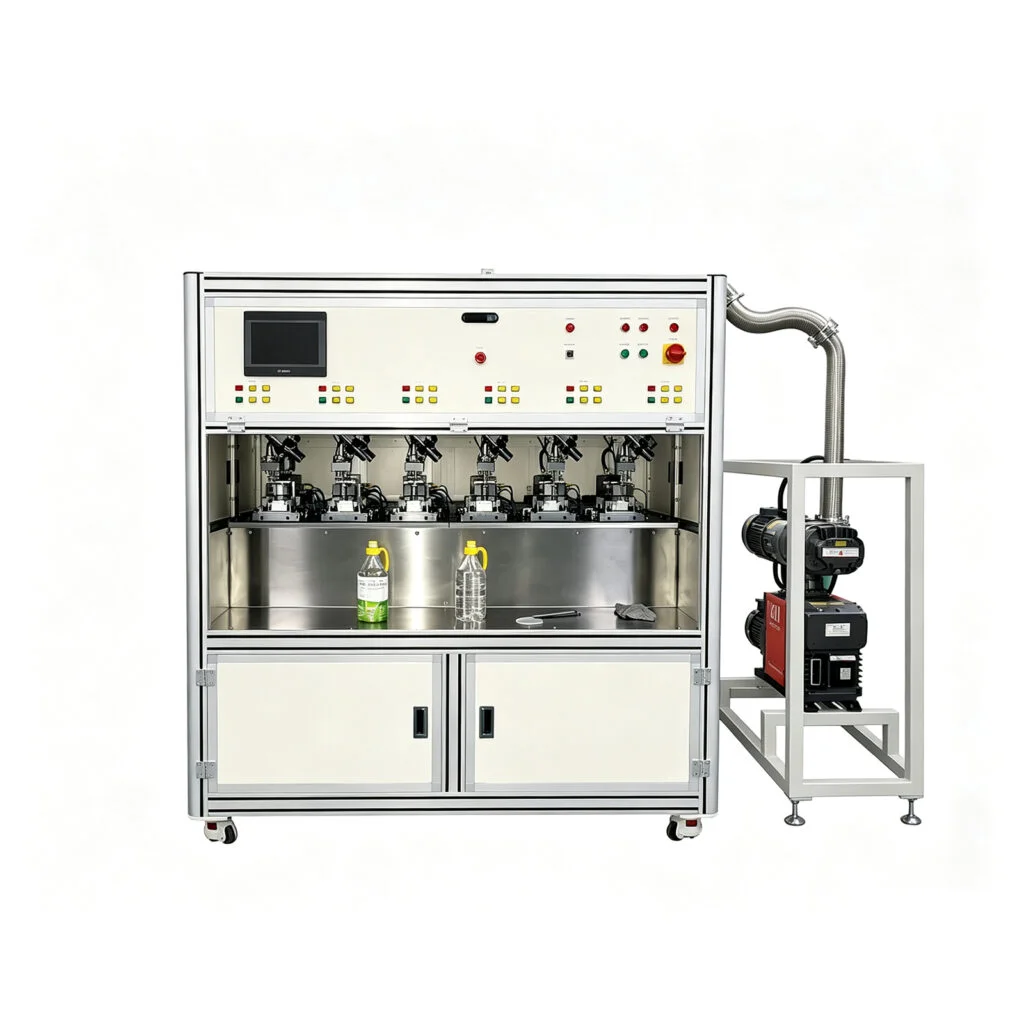
Vapor Chamber Production Line: Complete Manufacturing Guide
1. What Is a Vapor Chamber Production Line?
A vapor chamber production line combines specialized manufacturing equipment to produce flat, sealed, two-phase heat spreaders.
Unlike conventional metal plates, vapor chambers transfer heat through evaporation, condensation, and capillary liquid circulation.
Therefore, these components distribute concentrated heat across larger cooling surfaces.
A complete manufacturing system typically includes copper processing, wick preparation, assembly, vacuum processing, sealing, and thermal testing.
Furthermore, manufacturers can integrate automation equipment to improve production consistency and reduce manual operations.
Main Manufacturing Functions
The production system supports several essential operations:
- Copper sheet cutting and precision forming
- Copper powder filling and wick preparation
- High-temperature sintering
- Chamber assembly and positioning
- Vacuum degassing and fluid charging
- Precision laser welding
- Hot pressing and flattening
- Thermal performance testing
- Leak detection and quality inspection
Additionally, manufacturers can customize equipment configurations according to chamber dimensions and production capacity.
As a result, the same manufacturing concept supports different vapor chamber designs and applications.
2. How Does a Vapor Chamber Work?
A vapor chamber uses phase-change technology to transfer heat efficiently across a flat surface.
First, the heat source transfers thermal energy into the chamber’s evaporator region.
Next, the internal working fluid absorbs heat and changes into vapor.
Then, the vapor travels toward cooler areas inside the chamber.
Consequently, the vapor releases heat and condenses into liquid.
Finally, the internal wick structure returns the liquid toward the evaporator through capillary action.
This continuous cycle supports effective heat spreading without mechanical pumps.
Main Vapor Chamber Components
Copper Shell
The copper enclosure provides thermal conductivity and protects the internal components.
Capillary Wick Structure
The wick transports condensed liquid toward the evaporation region.
Working Fluid
The working fluid absorbs and releases heat through phase changes.
Internal Support Structures
Support pillars maintain chamber geometry under external pressure.
Hermetic Sealing Structure
The sealed enclosure maintains the internal environment necessary for reliable operation.
Therefore, manufacturing accuracy directly influences thermal resistance, reliability, and product lifespan.
3. Vapor Chamber Manufacturing Process
A complete vapor chamber production line follows several coordinated manufacturing stages.
However, specific production sequences depend on chamber geometry, wick technology, and sealing methods.
Step 1: Copper Material Preparation
First, manufacturers select copper materials according to product requirements.
Oxygen-free copper commonly supports vapor chamber manufacturing because of its thermal conductivity and processing characteristics.
Next, cutting equipment prepares copper sheets according to the required dimensions.
Additionally, cleaning equipment removes oil, particles, and surface contaminants.
Consequently, clean materials support reliable bonding and stable thermal performance.
Step 2: Copper Shell Forming
Next, precision forming equipment creates the upper and lower chamber shells.
Manufacturers commonly use stamping, machining, or other forming technologies.
Furthermore, accurate forming maintains consistent internal cavity dimensions.
Therefore, production teams carefully control shell thickness, flatness, and dimensional tolerances.
Step 3: Wick Structure Manufacturing
The wick structure plays a critical role in vapor chamber performance.
For example, manufacturers may use sintered copper powder, copper mesh, or machined grooves.
First, an Automatic Powder Filling Machine distributes copper powder across designated internal surfaces.
Next, a sintering furnace creates a porous structure through controlled thermal processing.
Consequently, the resulting wick supports capillary liquid circulation.
Furthermore, precise powder distribution improves structural consistency across production batches.
Internal Link Opportunity: Automatic Powder Filling Machine
Step 4: Sintering Process
Sintering strengthens the porous copper wick without completely melting the material.
First, technicians configure the furnace atmosphere and temperature profile.
Next, the furnace heats the copper powder under controlled conditions.
During this process, copper particles develop bonds while maintaining interconnected pores.
As a result, the wick supports liquid transport through capillary forces.
However, incorrect sintering conditions can reduce permeability or weaken the structure.
Therefore, manufacturers must control temperature, atmosphere, and processing duration carefully.
Internal Link Opportunity: Vacuum Sintering Furnace
Step 5: Chamber Assembly
After wick preparation, operators assemble the chamber components.
First, positioning fixtures align the upper and lower copper shells.
Next, technicians install internal support structures when the product design requires them.
Furthermore, precision alignment helps maintain consistent internal spacing.
Therefore, accurate assembly supports reliable sealing and uniform thermal performance.
Step 6: Chamber Bonding and Welding
Next, manufacturers join the copper enclosure while preserving a suitable filling or evacuation path.
Depending on the design, they may use laser welding, brazing, or diffusion bonding.
For example, laser welding offers localized heat input and precise seam control.
Meanwhile, diffusion bonding creates strong joints through controlled heat and pressure.
Consequently, equipment selection depends on chamber thickness, geometry, and production requirements.
Internal Link Opportunity: Vapor Chamber Fully Automatic Laser Sealing Machine
Step 7: Vacuum Degassing
Vacuum degassing removes unwanted gases from the chamber.
First, vacuum pumps reduce the internal pressure.
Next, suitable degassing processes remove air and other non-condensable gases.
Additionally, manufacturers may use controlled heating to support gas removal.
Consequently, the chamber maintains more favorable conditions for phase-change heat transfer.
However, residual gases can reduce the effective condensation area.
Therefore, accurate vacuum processing remains essential for consistent performance.
Internal Link Opportunities: Vacuum Degassing Machine, Six-Station Vacuum Degassing Machine
Step 8: Working Fluid Filling
After appropriate vacuum preparation, precision filling equipment introduces the working fluid.
Water commonly serves as the working fluid in copper vapor chambers for electronics cooling.
However, other designs may require different compatible fluids.
First, the filling system measures the required fluid quantity.
Next, controlled charging equipment introduces the fluid through the filling port.
Furthermore, accurate dosing helps maintain the intended liquid inventory.
Therefore, manufacturers must validate filling parameters for each chamber design.
Step 9: Final Sealing
Next, sealing equipment closes the filling port and completes the hermetic enclosure.
Depending on the chamber design, manufacturers may use pinch-off, welding, or combined sealing methods.
Furthermore, automatic laser systems can support repeatable sealing operations.
Consequently, consistent process control helps reduce leakage risks.
However, manufacturers must validate every sealing method against product reliability requirements.
Internal Link Opportunity: Vapor Chamber Fully Automatic Laser Sealing Machine
Step 10: Hot Pressing and Flattening
After sealing, some vapor chambers require additional shaping or flattening.
Therefore, manufacturers use precision hot pressing or flattening equipment when the design permits.
First, operators configure the required pressure and temperature conditions.
Next, the machine adjusts chamber geometry within the validated processing limits.
Consequently, the finished component can achieve the required contact-surface flatness.
However, excessive pressure may damage internal wick structures.
Internal Link Opportunity: Vapor Chamber Hot Press Hydraulic Machine
Step 11: Thermal Performance Testing
Finally, testing equipment evaluates the finished vapor chamber.
Manufacturers measure thermal resistance, temperature distribution, and heat spreading performance.
Additionally, leak detection equipment checks enclosure integrity.
Furthermore, dimensional inspection verifies thickness, flatness, and surface quality.
As a result, production teams can identify defective components before delivery.
Internal Link Opportunities: Multi-Station Thermal Performance Tester, Vapor Chamber Leak Testing Machine
4. Essential Equipment for Vapor Chamber Production
A modern vapor chamber production line integrates multiple specialized machines.
Each machine performs a specific function within the manufacturing workflow.
Therefore, equipment compatibility influences overall production efficiency and product quality.
Equipment | Main Function |
Copper Cutting Machine | Prepares copper sheets |
Copper Forming Machine | Creates chamber shells |
Automatic Powder Filling Machine | Distributes wick material |
Vacuum Sintering Furnace | Forms porous wick structures |
Laser Welding Machine | Joins copper components |
Vacuum Degassing Machine | Removes unwanted gases |
Precision Filling Machine | Controls working fluid quantity |
Automatic Laser Sealing Machine | Completes hermetic sealing |
Hot Press Hydraulic Machine | Adjusts chamber geometry |
Thermal Performance Tester | Measures heat transfer performance |
4.1 Automatic Powder Filling Machine
An automatic powder filling machine supports accurate copper powder distribution.
Furthermore, programmable dosing improves consistency between production cycles.
Consequently, manufacturers can reduce material waste and improve wick uniformity.
4.2 Vacuum Sintering Furnace
A vacuum sintering furnace provides controlled thermal processing for compatible wick designs.
Additionally, the system manages heating profiles and furnace atmosphere conditions.
Therefore, manufacturers can improve process repeatability through validated furnace settings.
4.3 Automatic Laser Sealing Machine
A laser sealing machine provides precise welding control for compatible chamber designs.
Furthermore, automated positioning helps maintain consistent welding paths.
As a result, manufacturers can improve sealing repeatability and reduce manual handling.
4.4 Vacuum Degassing Machine
Vacuum degassing equipment helps remove non-condensable gases.
Additionally, multi-station systems can process several components within coordinated production cycles.
Consequently, suitable configurations may increase throughput.
4.5 Hot Press Hydraulic Machine
A hot press hydraulic machine applies controlled pressure during compatible forming or flattening operations.
Furthermore, adjustable processing parameters support different product geometries.
Therefore, manufacturers can configure the machine around specific dimensional requirements.
4.6 Thermal Performance Testing Equipment
Thermal testing equipment evaluates heat transfer under controlled operating conditions.
For example, testing systems can measure temperature differences and thermal resistance.
Additionally, automated data collection supports production traceability.
Consequently, manufacturers can compare results across production batches.
5. Automatic vs. Semi-Automatic Production Lines
Manufacturers can choose different automation levels according to production requirements.
However, each configuration offers different advantages.
Feature | Automatic Line | Semi-Automatic Line |
Labor requirements | Lower manual involvement | More operator involvement |
Initial investment | Generally higher | Generally lower |
Production consistency | Strong automation potential | Depends more on operators |
Production flexibility | Requires suitable programming | Often easier for frequent manual changes |
Throughput | Potentially higher | Depends on staffing and equipment |
Best application | Stable, high-volume manufacturing | Smaller batches and development |
Automatic Production Systems
Automatic systems connect multiple processing stages through coordinated equipment.
Furthermore, robotic handling and programmable controls reduce repetitive manual operations.
Consequently, manufacturers can improve process consistency.
Semi-Automatic Production Systems
Semi-automatic systems combine specialized machines with manual loading or transfer operations.
Therefore, they may suit smaller factories or changing product requirements.
Additionally, manufacturers can upgrade individual stations as production demand increases.
6. Advantages of Automated Manufacturing
An automatic vapor chamber production line offers several potential manufacturing benefits.
Higher Production Efficiency
First, automation reduces repetitive handling operations.
Furthermore, coordinated equipment can shorten transfer times between manufacturing stages.
Consequently, suitable production layouts can improve overall throughput.
Improved Manufacturing Consistency
Automated equipment follows programmed processing parameters.
Therefore, manufacturers can reduce variation from manual adjustments.
Additionally, process monitoring helps identify deviations earlier.
Reduced Material Waste
Precision filling and forming equipment improves material control.
Consequently, manufacturers can reduce unnecessary copper powder consumption and processing losses.
Better Quality Management
Modern production systems can collect manufacturing data automatically.
Furthermore, traceability records help engineers investigate production problems.
Therefore, factories can improve process control and quality management.
Scalable Manufacturing Capacity
Modular production equipment supports future expansion.
For example, manufacturers can add processing stations when production demand increases.
As a result, factory upgrades may require fewer changes to the existing manufacturing layout.
7. Applications of Vapor Chamber Technology
Vapor chambers support thermal management across several industries.
Furthermore, their flat structures make them suitable for compact electronic assemblies.
7.1 AI Servers and Data Centers
AI processors generate concentrated thermal loads.
Therefore, advanced heat spreaders help transfer heat toward larger cooling assemblies.
Additionally, vapor chambers can support cooling designs with limited installation space.
7.2 Graphics Cards and Gaming Computers
Modern graphics processors require effective heat spreading.
Consequently, manufacturers integrate vapor chambers into selected GPU cooling systems.
Furthermore, these components help distribute heat toward fins and other cooling structures.
7.3 Laptops and Mobile Devices
Compact electronics provide limited space for thermal management.
Therefore, thin vapor chambers offer useful heat spreading capabilities.
Additionally, advanced manufacturing techniques support increasingly compact chamber designs.
7.4 Telecommunications Equipment
Communication systems often operate under continuous electrical loads.
Consequently, thermal management components help maintain suitable operating temperatures.
Furthermore, vapor chambers can support compact equipment designs.
7.5 Industrial Electronics
Industrial control equipment requires reliable thermal performance.
Therefore, manufacturers may use vapor chambers in high-power electronic assemblies.
Additionally, specialized designs can accommodate different installation conditions.
8. Key Factors Affecting Production Quality
Manufacturing quality depends on several interconnected factors.
Therefore, production engineers must evaluate the complete process rather than individual machines.
Copper Material Quality
First, copper purity and surface cleanliness influence manufacturing performance.
Additionally, material consistency supports repeatable forming and bonding operations.
Wick Structure Quality
Wick porosity and permeability affect liquid return performance.
Therefore, manufacturers must control powder characteristics and sintering conditions.
Vacuum Quality
Residual non-condensable gases can reduce heat transfer performance.
Consequently, vacuum processing requires suitable equipment and validated procedures.
Filling Accuracy
Incorrect fluid quantities can reduce chamber performance.
For example, insufficient fluid may cause local dry-out.
Meanwhile, excessive fluid may restrict vapor movement.
Therefore, filling parameters require product-specific validation.
Sealing Reliability
Reliable sealing helps maintain the internal operating environment.
Additionally, leak testing helps detect defects before shipment.
Thermal Testing Accuracy
Consistent testing conditions support meaningful performance comparisons.
Therefore, manufacturers should control heater power, sensor placement, and test orientation.
9. How to Choose a Vapor Chamber Production Line
Selecting suitable manufacturing equipment requires careful planning.
First, manufacturers should define their product specifications and production targets.
Next, they should compare available equipment configurations.
Important Selection Factors
Product Dimensions
Determine the required chamber length, width, and thickness.
Production Capacity
Estimate daily output and expected production growth.
Automation Requirements
Choose automatic or semi-automatic configurations according to production volume.
Manufacturing Process
Identify the wick technology, joining method, and fluid charging process.
Quality Requirements
Define acceptable leakage, flatness, thermal resistance, and reliability criteria.
Factory Layout
Evaluate available floor space, utilities, and material flow.
Technical Support
Confirm equipment commissioning, operator training, and maintenance arrangements.
Furthermore, manufacturers should evaluate sample production before making major investments.
Consequently, practical validation can reduce equipment selection risks.
10. Vapor Chamber Production Line Cost Factors
The investment required for a vapor chamber production line depends on several factors.
Therefore, manufacturers should avoid comparing quotations based only on equipment prices.
Equipment Configuration
First, complete manufacturing systems generally require more equipment than individual processing stations.
Consequently, the total investment increases with production scope.
Automation Level
Fully automatic configurations may require robotic handling, sensors, and integrated control systems.
Therefore, they often involve higher initial equipment costs.
Production Capacity
Higher throughput requirements may require additional processing stations.
Furthermore, manufacturers may need larger furnaces or multi-station vacuum systems.
Product Complexity
Ultra-thin chambers and complex geometries may require specialized equipment.
Consequently, tooling and process development can influence project costs.
Installation and Training
Equipment commissioning, operator training, and factory integration also affect project budgets.
Therefore, buyers should request quotations that clearly identify these services.
Operating Costs
Manufacturers should also consider electricity, maintenance, consumables, and labor.
Additionally, production yield and equipment utilization influence long-term manufacturing economics.
11. Why Choose cncooling-thermal?
cncooling-thermal focuses on thermal manufacturing equipment and vapor chamber production solutions.
Our website, https://cncoolingthermal.com/, provides a starting point for exploring relevant manufacturing technologies.
Furthermore, equipment selection should begin with actual product requirements.
Manufacturing Process Integration
A complete production solution must coordinate multiple manufacturing stages.
Therefore, cncooling-thermal emphasizes the importance of compatible equipment and practical production planning.
Application-Oriented Equipment Selection
Different vapor chamber designs require different processing methods.
Consequently, equipment configurations should reflect chamber dimensions, materials, and quality requirements.
Automation Planning
Modern factories increasingly require repeatable manufacturing processes.
Therefore, automation planning should consider production volume, labor requirements, and future expansion.
Quality-Focused Manufacturing
Reliable vapor chambers require consistent wick structures, vacuum processing, sealing, and testing.
Furthermore, manufacturers should establish measurable quality criteria before production begins.
Project Consultation
Buyers can contact cncooling-thermal to discuss equipment requirements and available manufacturing solutions.
Additionally, detailed product drawings and production targets help support technical discussions.
12. Future Trends in Vapor Chamber Manufacturing
Thermal management requirements continue evolving alongside electronic technology.
Consequently, vapor chamber manufacturing equipment must support increasingly demanding applications.
Ultra-Thin Vapor Chamber Manufacturing
Compact electronics require thinner thermal management components.
Therefore, manufacturers continue developing precise forming, wick fabrication, and sealing methods.
Higher Automation Levels
Factories increasingly adopt automated handling and process monitoring.
Furthermore, integrated production data supports improved traceability.
Advanced Wick Structures
Researchers continue investigating wick geometries and manufacturing methods.
Consequently, new equipment may support more complex internal structures.
Improved Quality Inspection
Automated inspection technologies can improve defect detection.
Additionally, digital production records support manufacturing analysis.
Flexible Manufacturing Systems
Manufacturers increasingly require equipment that supports different product designs.
Therefore, modular production concepts can help factories adapt to changing requirements.
13. Frequently Asked Questions
Q1: What is a vapor chamber production line?
A vapor chamber production line integrates equipment for manufacturing flat, two-phase heat transfer devices.
Furthermore, it typically includes forming, wick preparation, vacuum processing, sealing, and testing equipment.
Q2: What equipment does vapor chamber manufacturing require?
Manufacturing commonly requires copper forming equipment, wick processing machines, vacuum systems, welding equipment, and testing stations.
However, exact equipment requirements depend on the selected manufacturing process.
Q3: How does a vapor chamber production line work?
First, manufacturers prepare the copper enclosure and wick structure.
Next, they assemble, join, evacuate, and charge the chamber.
Finally, they seal and test the finished product.
Q4: What is the purpose of vacuum degassing?
Vacuum degassing removes unwanted gases from the internal chamber.
Consequently, the working fluid can circulate more effectively during phase-change heat transfer.
Q5: Why is laser welding important?
Laser welding offers precise energy control and localized heating.
Therefore, it can support reliable sealing for compatible vapor chamber designs.
Q6: Can manufacturers customize a vapor chamber production line?
Yes, manufacturers can configure equipment around specific chamber designs and production requirements.
Furthermore, automation levels can vary according to factory capacity.
Q7: What affects vapor chamber production quality?
Copper cleanliness, wick characteristics, vacuum conditions, filling accuracy, and sealing reliability all influence quality.
Additionally, consistent thermal testing helps verify product performance.
Q8: How much does a vapor chamber production line cost?
Costs depend on equipment selection, automation level, production capacity, and installation requirements.
Therefore, manufacturers should request quotations based on detailed project specifications.
Q9: What industries use vapor chambers?
Vapor chambers support cooling applications in AI servers, computers, telecommunications equipment, and industrial electronics.
Furthermore, compact electronic devices increasingly require advanced heat spreading solutions.
Q10: Where can I find vapor chamber manufacturing equipment?
Buyers can explore vapor chamber manufacturing technologies through cncooling-thermal.
Visit cncoolingthermal.com to learn more and discuss equipment requirements.
14. Conclusion
A vapor chamber production line provides an integrated solution for manufacturing advanced thermal management components.
Furthermore, precise equipment helps manufacturers control wick structures, vacuum conditions, fluid charging, and sealing quality.
Consequently, well-designed manufacturing systems can improve consistency, production efficiency, and quality management.
However, successful factory planning requires careful evaluation of product specifications and manufacturing requirements.
Therefore, manufacturers should consider equipment compatibility, automation levels, and long-term production goals.
cncooling-thermal provides information about thermal manufacturing equipment and related production solutions.
Visit https://cncoolingthermal.com/ to explore vapor chamber manufacturing technologies.
No related posts.