
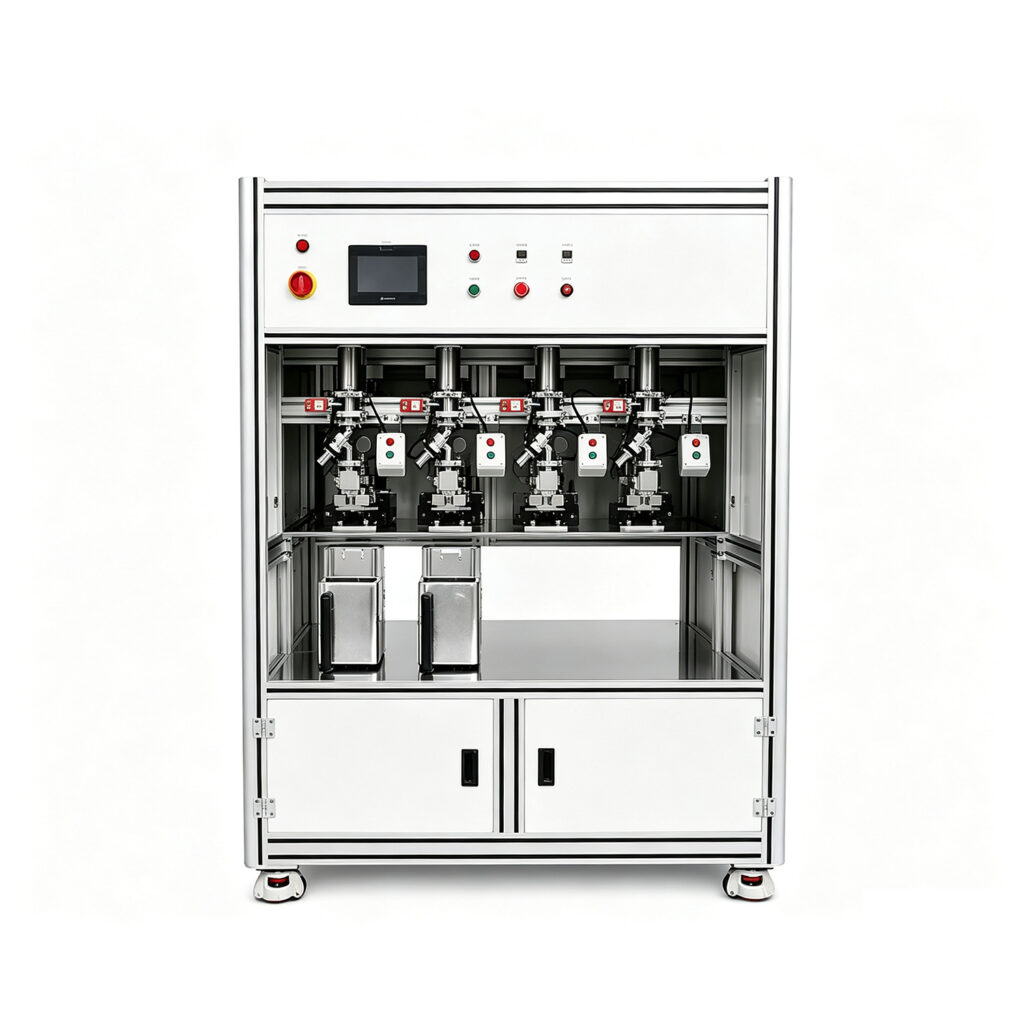
U-Shaped Heat Pipe Vacuum Machine: Complete Guide
1. What Is a U-Shaped Heat Pipe Vacuum Machine?
A U-Shaped Heat Pipe Vacuum Machine is specialized manufacturing equipment for vacuum processing U-shaped heat pipes.
U-shaped heat pipes have a bent tube structure. This design allows manufacturers to create specific thermal connection paths for different cooling applications.
However, their curved geometry creates additional manufacturing considerations. Tube positioning, internal preparation, vacuum connections, and working fluid handling require suitable equipment arrangements.
A vacuum machine helps establish the required internal conditions before working fluid filling and final sealing.
Depending on its configuration, the equipment may support:
- Vacuum evacuation.
- Internal gas removal.
- Multiple tube processing.
- Product positioning and clamping.
- Automatic operating sequences.
- Vacuum parameter monitoring.
- Integration with filling and welding equipment.
The exact functions depend on the machine design and production requirements.
For manufacturers producing U-shaped heat pipes, suitable vacuum equipment helps improve process consistency and production organization.
2. Why Is Vacuum Processing Important for U-Shaped Heat Pipes?
Heat pipes rely on phase-change heat transfer inside a sealed structure.
The working fluid evaporates in the heated section and condenses in the cooler section. Then, the wick structure returns the liquid toward the evaporation area.
This cycle requires suitable internal conditions.
2.1 Remove Non-Condensable Gases
Non-condensable gases can interfere with vapor movement and condensation.
They may also occupy internal areas that should support heat transfer.
Therefore, manufacturers need an appropriate evacuation process before final sealing.
2.2 Prepare the Internal Environment
Heat pipe manufacturing involves several preparation stages.
Cleaning, drying, and vacuum processing help reduce unwanted substances inside the tube.
A suitable vacuum process supports consistent working conditions before fluid charging.
2.3 Address U-Shaped Tube Geometry
U-shaped tubes require careful positioning during processing.
Their curved sections may create additional handling and fixture requirements.
Therefore, vacuum equipment should accommodate the actual tube dimensions and geometry.
2.4 Support Consistent Manufacturing
Manual vacuum connections may introduce differences between production cycles.
A suitable machine can standardize positioning, connection, and operating procedures.
Furthermore, automatic process control helps reduce repetitive manual adjustments.
3. How Does a U-Shaped Heat Pipe Vacuum Machine Work?
The working process depends on machine configuration and heat pipe design.
However, a typical vacuum processing sequence includes several stages.
3.1 Tube Loading and Positioning
Operators place U-shaped heat pipes into dedicated fixtures.
The fixture supports the tube during processing and helps maintain stable positioning.
Its design should match tube diameter, length, bend radius, and connection position.
3.2 Vacuum Connection
The machine connects the tube to the vacuum system.
Suitable sealing interfaces help establish reliable connections.
Manufacturers should consider connection compatibility and fixture maintenance.
3.3 Vacuum Evacuation
The vacuum system reduces internal pressure to remove unwanted gases.
The required vacuum conditions depend on product specifications and manufacturing procedures.
The machine may use programmed evacuation sequences according to its configuration.
3.4 Process Monitoring
The control system monitors relevant operating parameters.
Depending on the equipment, these may include vacuum pressure, processing time, and machine status.
Operators can use these records to review production conditions.
3.5 Process Completion
After the programmed cycle finishes, the equipment follows its configured release procedure.
Operators can then transfer the tubes to the next manufacturing stage.
This may include working fluid filling and sealing.
3.6 Inspection and Verification
Manufacturers should verify process consistency through suitable inspection procedures.
They should also maintain records of vacuum processing conditions.
This supports production traceability and process improvement.
4. Main Features of U-Shaped Heat Pipe Vacuum Equipment
Equipment configurations vary according to production requirements.
Buyers should evaluate the following features before purchasing.
4.1 Dedicated U-Shaped Tube Fixtures
U-shaped heat pipes require suitable positioning arrangements.
Dedicated fixtures help support curved tube sections during processing.
They should match the product’s dimensions and geometry.
4.2 Vacuum Pump System
The vacuum pump provides the pressure reduction required for evacuation.
Manufacturers should review pump configuration and relevant vacuum specifications.
The system should match the required processing conditions.
4.3 Automatic Control System
Automatic controls can manage the vacuum operating sequence.
Depending on the design, operators may set processing parameters through a control interface.
This supports standardized operating procedures.
4.4 Multi-Station Processing Options
Some equipment configurations support multiple processing stations.
This arrangement may allow several tubes to undergo vacuum processing during one cycle.
However, station quantity and practical capacity depend on the machine design.
4.5 Vacuum Monitoring
Vacuum monitoring helps operators review process conditions.
Suitable sensors and control functions support process verification.
Manufacturers should confirm the monitoring range and accuracy before purchase.
4.6 Production Line Compatibility
The machine should connect logically with upstream and downstream processes.
For example, it may receive prepared U-shaped tubes and transfer them to filling equipment.
Suitable material handling reduces unnecessary manual operations.
5. Applications in U-Shaped Heat Pipe Manufacturing
U-shaped heat pipes support different thermal management designs.
Their curved structure helps manufacturers adapt heat transfer paths to specific installation conditions.
5.1 Electronic Cooling Systems
Electronic devices often require compact thermal management components.
U-shaped heat pipes can provide flexible connections between heat sources and cooling sections.
Suitable vacuum processing supports internal preparation during manufacturing.
5.2 Computer and Server Cooling
High-performance computing systems generate significant heat.
Heat pipes help transfer heat toward heat sinks or other cooling structures.
U-shaped configurations may suit certain compact cooling assemblies.
5.3 Industrial Thermal Management
Industrial equipment may require customized heat transfer components.
U-shaped heat pipes can support thermal layouts with specific installation constraints.
Manufacturers should match tube geometry and operating requirements to the application.
5.4 Customized Heat Pipe Assemblies
Some customers require special dimensions, bend radii, and connection positions.
These designs may need customized fixtures and vacuum connections.
Therefore, equipment selection should consider representative product drawings.
6. Benefits of Automatic Vacuum Processing
Automatic vacuum processing can improve manufacturing organization.
However, actual benefits depend on equipment configuration and process management.
6.1 Consistent Vacuum Procedures
Programmed operating sequences help standardize processing conditions.
This can reduce variation caused by repeated manual adjustments.
6.2 Reduced Manual Handling
Dedicated fixtures simplify tube positioning.
Automatic processing can also reduce repetitive operator intervention.
6.3 Improved Production Efficiency
Multiple processing stations may increase the number of tubes handled per cycle.
Suitable equipment capacity also helps coordinate downstream operations.
6.4 Better Process Monitoring
Digital monitoring can provide useful operating records.
Manufacturers can review vacuum conditions and identify process deviations.
6.5 Flexible Production Management
Adjustable fixtures and suitable control functions can support different U-shaped heat pipe models.
However, buyers should confirm the actual adjustment range.
7. How to Select the Right Vacuum Machine
Selecting suitable equipment requires detailed product information.
Manufacturers should evaluate both technical specifications and production requirements.
7.1 Confirm Tube Dimensions
Provide the supplier with:
- Tube diameter.
- Tube length.
- Overall U-shaped dimensions.
- Bend radius.
- Material specifications.
- Vacuum connection position.
These details help determine fixture and machine requirements.
7.2 Evaluate Vacuum Performance
Check the vacuum system specifications and operating range.
Also, discuss evacuation time and process stability.
Actual requirements depend on tube volume and manufacturing procedures.
7.3 Check Fixture Compatibility
The fixture must support the product geometry.
It should also provide reliable positioning and suitable vacuum connections.
Manufacturers producing multiple models should discuss interchangeable fixtures.
7.4 Review Automation Functions
Check the operating interface and process control functions.
Relevant features may include automatic evacuation, pressure monitoring, cycle control, and alarm functions.
Choose functions that match actual production needs.
7.5 Evaluate Production Capacity
Determine the required output per hour or shift.
Then, compare station quantity, cycle time, loading time, and unloading time.
This helps avoid selecting equipment with insufficient capacity.
7.6 Confirm Maintenance Requirements
Ask about pump maintenance, seals, valves, sensors, and replacement parts.
Clear maintenance arrangements help support long-term operation.
8. Integration with a Heat Pipe Production Line
A U-shaped Heat Pipe Vacuum Machine should operate within a coordinated manufacturing process.
A typical production sequence may include:
- Copper tube cutting.
- Tube bending and forming.
- Internal cleaning.
- Wick preparation.
- Powder filling and sintering, when applicable.
- Dry-out and internal preparation.
- Vacuum evacuation.
- Working fluid filling.
- Sealing and welding.
- Final inspection and testing.
The exact sequence depends on the selected heat pipe structure.
8.1 Connection with Tube Bending Equipment
U-shaped heat pipes require accurate bending operations.
The bending process should maintain the required tube geometry and avoid unwanted deformation.
Therefore, vacuum fixtures should match the finished tube shape.
Related internal link: Heat Pipe Tube Bending Equipment.
8.2 Connection with Dry-Out Equipment
Dry-out equipment helps remove residual moisture before subsequent processing.
Vacuum processing then supports the removal of unwanted gases.
Some manufacturing systems combine related functions. Others use separate machines.
Related internal link: Heat Pipe Multi-Station Dry-Out Tester.
8.3 Connection with Filling and Welding Equipment
Vacuum processing generally takes place before working fluid charging.
The next stage introduces the specified fluid and completes tube sealing.
Related internal link: Heat Pipe Filling & Welding Machine.
8.4 Connection with Testing Equipment
Finished products require suitable quality inspection.
Depending on specifications, manufacturers may perform leak testing and thermal performance evaluation.
Related internal link: Heat Pipe Thermal Performance Tester.
9. Common Vacuum Processing Problems and Solutions
Manufacturers may encounter several issues during vacuum processing.
Proper equipment maintenance and process control help reduce these problems.
9.1 Vacuum Pressure Cannot Reach the Target
Possible causes include leakage, pump performance problems, or unsuitable connections.
Check seals, pipelines, valves, and vacuum system components.
9.2 Unstable Vacuum Readings
Unstable readings may indicate leakage or sensor problems.
Manufacturers should inspect connection points and verify sensor condition.
9.3 Poor Tube Positioning
Incorrect positioning can affect vacuum connections.
Review fixture dimensions and loading procedures.
Customized fixtures may be necessary for different U-shaped models.
9.4 Excessive Processing Time
Long evacuation cycles can reduce production efficiency.
Review tube volume, connection design, pump condition, and process settings.
Do not reduce processing time without confirming the required internal conditions.
9.5 Frequent Equipment Downtime
Vacuum pumps, seals, and valves require suitable maintenance.
Manufacturers should establish regular inspection procedures.
They should also keep critical replacement parts available.
10. Why Choose cncooling-thermal?
cncooling-thermal focuses on thermal manufacturing equipment and related production solutions.
Manufacturers producing U-shaped heat pipes need equipment that accommodates tube geometry and internal processing requirements.
A suitable vacuum machine should match product dimensions, vacuum specifications, fixture design, and production targets.
Relevant equipment categories may include:
- U-Shaped Heat Pipe Vacuum Machine.
- Automatic Heat Pipe Heating Degasser Machine.
- Heat Pipe Multi-Station Dry-Out Tester.
- Heat Pipe Powder Filling Machine.
- Vacuum Sintering Furnace.
- Heat Pipe Filling & Welding Machine.
- Heat Pipe Thermal Performance Testing Equipment.
Each machine supports a different manufacturing stage.
Therefore, manufacturers should evaluate the complete production workflow before selecting individual machines.
cncooling-thermal can help customers discuss suitable equipment configurations for different heat pipe manufacturing projects.
Visit cncooling-thermal.com to explore thermal manufacturing equipment and discuss your production requirements.
11. Frequently Asked Questions
Q1. What is a U-Shaped Heat Pipe Vacuum Machine?
It is specialized equipment designed for vacuum processing U-shaped heat pipes during manufacturing.
It helps remove unwanted internal gases before subsequent filling and sealing operations.
Q2. Why do U-shaped heat pipes require vacuum processing?
Vacuum processing helps establish suitable internal conditions.
It supports the removal of non-condensable gases before working fluid filling and final sealing.
Q3. Can one vacuum machine process different U-shaped heat pipe sizes?
This depends on the fixture design and supported operating range.
Manufacturers should provide tube drawings and dimensions before equipment selection.
Q4. What factors affect vacuum processing time?
Processing time depends on tube volume, vacuum system performance, connection design, and process requirements.
The actual cycle should be verified through suitable testing.
Q5. Does the machine require special fixtures?
U-shaped products generally need suitable positioning and connection arrangements.
Dedicated fixtures can improve product support and process consistency.
Q6. What is the difference between a vacuum machine and a heating degasser machine?
A vacuum machine focuses on evacuation and internal gas removal.
A heating degasser machine combines heating with vacuum-related processing. The exact functions depend on equipment configuration.
Q7. Can the machine connect with automatic filling equipment?
Yes, suitable equipment integration can connect vacuum processing with downstream filling operations.
However, manufacturers must confirm handling methods and control interfaces.
Q8. What should buyers provide when requesting a quotation?
Provide tube dimensions, bend radius, product drawings, vacuum requirements, and expected production volume.
These details help suppliers evaluate machine configuration.
Q9. How should manufacturers maintain vacuum equipment?
Maintenance may include pump inspection, seal checks, valve inspection, sensor verification, and pipeline inspection.
Follow the equipment supplier’s maintenance recommendations.
Q10. Can cncooling-thermal provide customized vacuum equipment?
Equipment configuration should reflect tube geometry, process requirements, and production targets.
Contact cncooling-thermal with product drawings to discuss a suitable solution.