
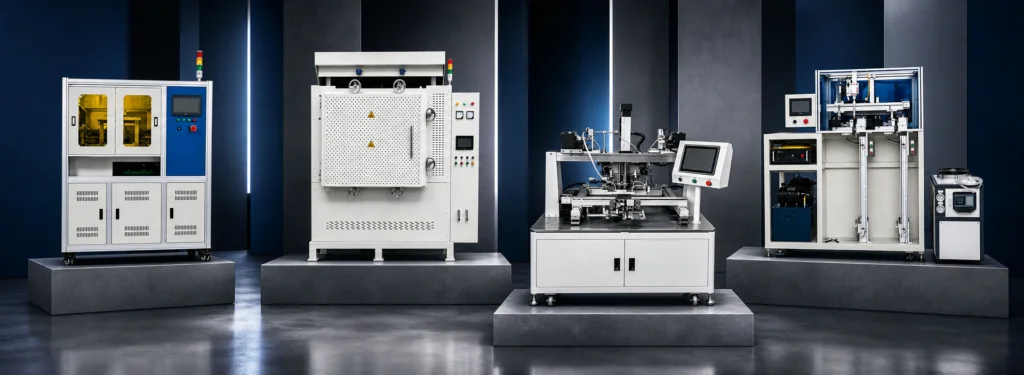
Ultra-thin Vapor Chamber Laser Sealing Machine Guide
Introduction
Ultra-thin vapor chambers help manage heat in compact electronic devices. Their thin profiles allow engineers to spread heat across limited spaces.
However, manufacturing these components requires precise control over materials, joining processes, and enclosure integrity. The sealing process must protect the internal structure while maintaining the required dimensions.
An Ultra-thin Vapor Chamber Laser Sealing Machine uses a laser-based joining process to seal designated joints or openings in ultra-thin vapor chamber assemblies. Its suitability depends on the chamber design, material thickness, joint geometry, and production requirements.
Furthermore, laser sealing can support localized heat input and precise energy delivery. Manufacturers must still validate the process to prevent distortion, incomplete joints, and leakage.
This guide explains the machine’s working principles, key components, benefits, applications, and selection criteria. It also outlines quality-control practices for manufacturers developing ultra-thin thermal management products.
1. What Is an Ultra-thin Vapor Chamber Laser Sealing Machine?
An Ultra-thin Vapor Chamber Laser Sealing Machine is specialized equipment for laser joining operations in thin vapor chamber manufacturing.
A vapor chamber typically contains a sealed metal enclosure, an internal wick structure, and a working fluid. During operation, the fluid evaporates near the heat source and moves toward cooler regions. It then condenses and releases heat.
Meanwhile, the wick structure returns liquid toward the evaporation region. This phase-change process allows the chamber to spread heat across its surface.
Ultra-thin designs create additional manufacturing challenges. Their walls and internal structures may tolerate only limited deformation. Consequently, manufacturers must control fixture pressure, joint alignment, and welding parameters carefully.
Laser sealing directs energy into a localized area. Depending on the design, the process may join enclosure edges or seal a designated opening. The exact method depends on the product’s construction.
Therefore, buyers should distinguish between perimeter sealing, port sealing, and other laser welding operations. These processes may require different fixtures and equipment configurations.
An appropriate machine should match the actual chamber geometry and production workflow. Manufacturers should confirm these capabilities through technical review and sample testing.
2. Why Laser Sealing Matters for Ultra-thin Vapor Chambers
2.1 Controlling Heat Input
Ultra-thin metal components can be sensitive to localized heating. Excessive heat may cause distortion or affect nearby structures.
Laser welding concentrates energy within a defined processing area. Therefore, it can offer useful control when the joint design and parameters suit the material.
However, laser welding does not automatically prevent distortion. Material thickness, clamping conditions, joint fit-up, and heat distribution still influence results.
2.2 Maintaining Dimensional Accuracy
Ultra-thin vapor chambers often need to fit within compact product assemblies. Small dimensional changes may affect downstream assembly.
Consequently, manufacturers need stable positioning and repeatable joining conditions. Suitable fixtures help maintain alignment throughout the sealing process.
Furthermore, process qualification should include dimensional checks. These checks help verify that the finished chamber meets drawing requirements.
2.3 Protecting Enclosure Integrity
A vapor chamber relies on a sealed enclosure to maintain its internal operating environment.
Therefore, sealing defects can affect product reliability. Incomplete joints, pores, cracks, or other discontinuities may create leakage paths.
Laser parameters must suit the material and joint geometry. Additionally, manufacturers should use appropriate inspection and leak-testing procedures.
2.4 Supporting Repeatable Manufacturing
Manual joining may introduce variation in positioning, energy delivery, and processing speed.
An automated laser sealing machine can standardize selected process steps. Furthermore, recipe control can help operators repeat approved settings across production batches.
However, repeatability depends on machine condition, fixture accuracy, material consistency, and operator procedures. Manufacturers should validate the complete process rather than relying on automation alone.
3. How the Machine Works
The operating sequence varies according to the machine configuration and vapor chamber design. A typical laser sealing workflow includes the following stages.
Step 1: Load the Workpiece
First, the operator or automated handling system places the chamber components into the fixture.
The fixture establishes the required position and alignment. Furthermore, appropriate support helps limit movement during welding.
Step 2: Verify Joint Alignment
Next, the system positions the intended sealing area beneath the laser head.
The joint must meet the specified fit-up and alignment requirements. Consequently, manufacturers should inspect component preparation and fixture repeatability.
Step 3: Set the Welding Recipe
The operator selects an approved recipe for the relevant product model.
Depending on the system, parameters may include laser power, pulse settings, travel speed, focus position, and weld path.
However, the appropriate values depend on material, thickness, joint geometry, and laser configuration. Manufacturers should establish them through controlled trials.
Step 4: Perform Laser Sealing
The laser delivers energy along the programmed joint or designated sealing path.
The material melts locally and forms a joint as the molten region solidifies. Therefore, stable motion and suitable energy delivery are essential.
The actual welding pattern depends on the chamber design. Some applications require continuous seams, while others use a different joint configuration.
Step 5: Complete the Process
After welding, the system finishes the programmed cycle. The operator or automation system then removes the workpiece.
Depending on the process, the chamber may require cleaning, dimensional inspection, leak testing, or additional manufacturing operations.
Step 6: Verify Sealing Quality
Finally, the manufacturer evaluates the completed joint against established acceptance criteria.
Visual inspection can identify some surface defects. However, it cannot reliably confirm every internal defect or leakage path.
Therefore, manufacturers should select inspection methods according to product specifications and customer requirements.
4. Main Machine Components
4.1 Laser Source
The laser source generates the energy used for joining the selected metal components.
Its suitability depends on the material, thickness, joint geometry, and required processing speed. Furthermore, beam characteristics influence how energy interacts with the workpiece.
Buyers should confirm the proposed laser source and its suitability for their specific chamber design.
4.2 Optical Delivery System
The optical system directs the laser beam toward the intended welding area.
Depending on the configuration, it may include beam-delivery components and a focusing head. Stable optical alignment helps maintain consistent processing conditions.
Additionally, manufacturers should follow the supplier’s maintenance and cleaning instructions.
4.3 Precision Fixture
The fixture holds and aligns the ultra-thin chamber during welding.
A suitable fixture supports the workpiece without creating excessive deformation. Therefore, its design must reflect chamber dimensions, material thickness, and joint location.
For multi-model production, interchangeable fixtures may improve flexibility. Buyers should confirm the supported product range and changeover procedure.
4.4 Motion and Positioning System
The motion system moves the laser head or workpiece along the programmed welding path.
Its configuration depends on the required working area and path complexity. Furthermore, positioning accuracy influences weld placement.
Manufacturers should evaluate path repeatability using representative production components.
4.5 Industrial Control System
The control system coordinates machine operation and manages the selected welding recipe.
Depending on the configuration, it may support parameter storage, alarm handling, and production records. These functions can help operators follow approved procedures.
However, available controls vary by machine model. Buyers should confirm the actual functions before ordering.
4.6 Safety Protection System
Laser equipment requires safeguards appropriate to its laser class and installation.
These safeguards may include an enclosure, access interlocks, warning indicators, and suitable protective measures. Furthermore, the installation must follow applicable regulations and the equipment supplier’s safety instructions.
Manufacturers should conduct a documented risk assessment before operating the system.
5. Key Technical Features
When evaluating an Ultra-thin Vapor Chamber Laser Sealing Machine, buyers should prioritize measurable requirements.
5.1 Suitable Laser Parameters
The laser configuration must suit the target material and joint design.
Manufacturers should validate the processing window using representative workpieces. Consequently, they can identify settings that produce acceptable joints without unnecessary thermal damage.
5.2 Stable Workpiece Positioning
Accurate positioning helps maintain the intended weld path.
Furthermore, repeatable clamping reduces variation caused by workpiece movement. The fixture should support thin components without introducing unacceptable deformation.
5.3 Programmable Welding Paths
A programmable path can support repeatable processing across defined product models.
Depending on the machine, operators may store different recipes for different chamber designs. However, every recipe should undergo appropriate validation before production use.
5.4 Consistent Process Control
Stable control of relevant parameters helps reduce process variation.
These parameters may include laser output, travel speed, focus position, and timing. The specific control functions depend on the equipment configuration.
5.5 Flexible Production Capability
Manufacturers may produce different chamber dimensions or enclosure geometries.
Therefore, buyers should evaluate fixture changes, programming requirements, and model changeover time. They should also confirm the machine’s working area and supported joint paths.
5.6 Traceability and Monitoring
Production records can help quality teams investigate defects and identify process changes.
Depending on the system, records may include product identifiers, recipe numbers, alarms, and welding parameters. Buyers should specify data requirements before equipment selection.
6. Benefits of Laser Sealing
6.1 Localized Energy Delivery
Laser welding concentrates energy around the intended joint.
Consequently, it may reduce unnecessary heating of nearby areas compared with some broader heat-input processes. Actual results depend on the welding method and material configuration.
6.2 Potential for Reduced Distortion
A suitable laser process can limit the heated region. Therefore, it may help manufacturers control deformation in certain thin-metal applications.
However, low distortion is not guaranteed. Fixture design, material properties, joint preparation, and welding parameters remain important.
6.3 Repeatable Processing
Automated motion and recipe control can standardize selected welding operations.
Furthermore, programmed paths help maintain consistent weld placement. Manufacturers should still monitor equipment condition and product variation.
6.4 Support for Compact Product Designs
Ultra-thin vapor chambers require manufacturing processes that accommodate limited thickness and restricted geometry.
Laser sealing can suit certain compact joining applications. Nevertheless, manufacturers must validate the process against the actual chamber design.
6.5 Integration With Automated Production
A laser sealing machine may connect with upstream assembly and downstream inspection equipment.
Consequently, manufacturers can design a more coordinated workflow. The required automation level depends on production volume, product variety, and investment priorities.
7. Applications Across Industries
Ultra-thin vapor chambers support thermal management in compact electronic products. Therefore, laser sealing equipment may serve manufacturers in several markets.
7.1 Smartphones and Tablets
Mobile devices combine limited internal space with increasing heat loads.
Ultra-thin vapor chambers can spread heat across a larger area. Consequently, manufacturers need sealing processes that accommodate compact geometries and thin metal structures.
7.2 Laptop Computers
Laptops require thermal management within restricted internal dimensions.
Vapor chambers can help distribute heat from processors and other high-power components. Meanwhile, stable sealing supports the intended internal operating environment.
7.3 High-Performance Computing
Processors, graphics hardware, and computing accelerators can generate concentrated heat.
Vapor chambers may help spread this heat toward downstream cooling components. Therefore, manufacturers need suitable production controls and product-level thermal validation.
7.4 Telecommunications Electronics
Communication devices often combine compact enclosures with continuous operating demands.
Effective thermal management helps engineers manage component temperatures. Furthermore, consistent chamber manufacturing supports product quality requirements.
7.5 Other Compact Electronics
Industrial controllers, portable devices, and specialized electronic systems may also use thin thermal management components.
However, each application has different operating and mechanical requirements. Manufacturers should validate the chamber design and sealing process for its intended use.
8. How to Choose the Right Machine
Selecting equipment requires a clear understanding of the product and production process.
8.1 Provide Detailed Product Drawings
Start with chamber dimensions, material specifications, thickness, joint geometry, and tolerance requirements.
Additionally, identify the exact area requiring laser sealing. Clear drawings help the supplier assess fixture and process requirements.
8.2 Confirm Material Compatibility
Different metals interact with laser energy in different ways.
Therefore, the laser source and processing parameters must suit the selected material. Manufacturers should request trials using their actual materials.
8.3 Define Quality Requirements
Specify the required weld appearance, dimensional tolerances, leakage criteria, and other acceptance standards.
Furthermore, clarify the inspection methods and test conditions. This helps align equipment design with product requirements.
8.4 Evaluate Production Capacity
Define expected output, operating shifts, product mix, and acceptable cycle time.
However, cycle time should reflect the complete process. Loading, clamping, welding, unloading, and inspection can all affect throughput.
Request demonstrated cycle-time data for representative workpieces rather than relying only on theoretical speed.
8.5 Check Fixture Flexibility
If the factory produces multiple chamber models, ask how the machine handles changeovers.
Furthermore, confirm whether the system supports interchangeable fixtures and stored recipes. Evaluate the time and skill required to change models.
8.6 Review Safety and Service Requirements
Confirm the laser protection arrangement, operator training needs, maintenance schedule, and service support.
Additionally, clarify spare parts and routine inspection requirements before purchasing.
8.7 Conduct Sample Testing
Finally, provide representative workpieces for process evaluation.
Review the weld appearance, dimensional results, leakage performance, and other required quality indicators. Consequently, the decision can rely on demonstrated performance rather than assumptions.
9. Quality Control for Ultra-thin Vapor Chambers
Quality control should cover component preparation, laser sealing, and final product inspection.
9.1 Incoming Material Inspection
Verify material type, thickness, dimensions, and surface condition.
Furthermore, confirm that components meet the approved drawings. Inconsistent incoming materials may affect joint formation and final dimensions.
9.2 Joint Preparation
Cleanliness and joint fit-up can influence welding quality.
Therefore, establish suitable cleaning and handling procedures before sealing. The exact requirements depend on the material and manufacturing process.
9.3 Welding Parameter Verification
Use approved recipes and monitor relevant process variables.
Additionally, review alarms and deviations according to documented procedures. Changes to critical parameters should undergo suitable validation.
9.4 Visual and Dimensional Inspection
Inspect the weld and surrounding area for visible defects or unacceptable deformation.
Measure critical dimensions against the product drawing. However, these checks may not detect all internal defects.
9.5 Leak Testing
Where enclosure integrity is critical, use an appropriate leak-testing method.
The selected method should reflect the product requirements and acceptance limits. Furthermore, manufacturers should document test conditions and results.
9.6 Thermal Performance Verification
Thermal testing can assess whether the finished chamber meets its performance requirements.
For meaningful results, standardize the test setup and operating conditions. Additionally, investigate deviations before approving the product for production release.
10. Common Sealing Challenges and Solutions
10.1 Excessive Thermal Distortion
Excessive distortion may result from unsuitable heat input, poor clamping, or inconsistent joint fit-up.
Therefore, review the fixture and welding parameters together. Conduct controlled trials before making broad production changes.
10.2 Incomplete Joint Formation
An incomplete joint may result from insufficient energy, poor alignment, surface contamination, or an unsuitable joint design.
Consequently, inspect the workpiece and verify the process window. Do not assume that increasing laser power alone will solve the issue.
10.3 Porosity or Surface Defects
Surface contamination and unstable welding conditions can contribute to defects.
Furthermore, material condition and joint geometry may affect the result. Manufacturers should identify the underlying cause through structured process analysis.
10.4 Leakage After Sealing
Leakage may originate from incomplete joints, cracks, pores, or other enclosure defects.
Therefore, combine appropriate leak testing with weld inspection. Record failures and corrective actions to support continuous improvement.
10.5 Inconsistent Results Between Batches
Variation may arise from material differences, fixture wear, recipe changes, or unstable equipment conditions.
Consequently, standardize critical process parameters and monitor relevant production data. Regular maintenance also helps preserve repeatability.
11. Maintenance and Operational Best Practices
A structured maintenance plan supports reliable equipment operation.
First, inspect fixtures and clamping components for wear or damage. Next, check the laser head and optical components according to the supplier’s instructions.
Furthermore, keep the work area clean and prevent contamination of critical surfaces. Contamination may affect both welding quality and equipment performance.
Verify motion-system condition and positioning repeatability at the recommended intervals. Additionally, inspect safety devices and interlocks before operation.
Operators should use approved recipes and document abnormal conditions. Maintenance personnel should review recurring alarms and production defects.
Finally, follow the equipment manufacturer’s service schedule. Maintenance intervals should reflect actual operating conditions and supplier recommendations.
12. Integration Into a Vapor Chamber Production Line
An Ultra-thin Vapor Chamber Laser Sealing Machine often serves as one stage within a broader production workflow.
Upstream processes may include metal forming, wick preparation, cleaning, component assembly, and initial joining. The laser sealing station then completes the designated joint or closure operation.
Downstream processes may include cleaning, dimensional inspection, leak testing, vacuum filling, and thermal performance verification. The exact sequence depends on the chamber design.
Therefore, manufacturers should plan the complete workflow before installing individual machines.
For example, upstream assembly must provide correctly positioned components. Meanwhile, downstream equipment must accommodate the output rate and product specifications.
Relevant internal-link opportunities include:
Vapor Chamber Production Line — connect to the overall manufacturing solution.
Laser Welding Machine for Vapor Chamber — connect to the broader laser welding equipment page.
Vapor Chamber Vacuum Filling & Welding Machine — connect to the vacuum filling and sealing process.
Vapor Chamber Hot Press Hydraulic Machine — connect to the relevant forming or pressing equipment.
Multi-Station Thermal Performance Tester — connect to thermal verification equipment.
Use these anchors only when corresponding pages exist. Each link should direct readers to the most relevant product or technical page.
13. Frequently Asked Questions
13.1 What Is an Ultra-thin Vapor Chamber Laser Sealing Machine?
It is equipment designed to laser-seal specified joints or openings in ultra-thin vapor chamber assemblies. The machine configuration depends on chamber geometry, materials, and production requirements.
13.2 Why Use Laser Sealing for Ultra-thin Vapor Chambers?
Laser welding delivers energy to a localized region. This can suit certain thin-metal joining applications, provided the process meets the required quality standards.
13.3 Can Laser Sealing Prevent All Distortion?
No. Distortion depends on heat input, material properties, joint geometry, clamping, and welding sequence. Manufacturers must validate the process using representative workpieces.
13.4 Which Materials Can the Machine Process?
Material compatibility depends on the laser configuration and joint design. Buyers should provide material specifications and arrange sample testing before confirming equipment suitability.
13.5 How Do Manufacturers Verify Sealing Quality?
Manufacturers can use visual inspection, dimensional measurement, and suitable leak testing. Additional testing may be necessary when product specifications require it.
13.6 Can One Machine Handle Multiple Chamber Models?
Some systems can support multiple models through adjustable programs and interchangeable fixtures. However, the supported range depends on the machine’s design and working area.
13.7 What Information Should Buyers Provide?
Provide product drawings, material details, thickness, joint geometry, production targets, and quality requirements. Additionally, explain automation and traceability needs.
13.8 Does Laser Sealing Replace Vacuum Filling?
Not necessarily. Laser sealing and vacuum filling are related but distinct manufacturing operations. Some production workflows use separate machines, while others integrate multiple functions into one system.
The appropriate configuration depends on the chamber design and manufacturing sequence.
14. Conclusion
An Ultra-thin Vapor Chamber Laser Sealing Machine supports precision joining in thin thermal management component manufacturing. Its performance depends on the laser configuration, fixture design, joint geometry, process control, and quality verification.
Furthermore, manufacturers should evaluate the complete workflow rather than focusing only on welding speed. Reliable results require suitable materials, stable positioning, validated parameters, and effective inspection.
Before selecting equipment, buyers should provide detailed product drawings and define measurable acceptance criteria. Sample testing can then confirm whether the proposed configuration meets actual production needs.
cncooling-thermal can use this topic to explain its vapor chamber manufacturing equipment and related production solutions. Visit cncooling-thermal for company and product information.